
A question that would have sounded absurd twenty years ago is now being discussed seriously across the internet, political circles, universities, and diplomatic spaces around the world. Is Xi Jinping becoming the leader of what people once confidently called the “free world”? The reason this question is gaining traction is not because China suddenly conquered nations militarily or replaced the United States overnight. The reason is far deeper and far more uncomfortable for Washington. The United States increasingly looks divided, exhausted, insecure, and uncertain about its own future, while China projects stability, discipline, industrial strength, long term planning, and national confidence. That contrast is changing how millions of people across the world now see global power.
The latest debate erupted after Marco Rubio stated that America was not trying to constrain China, but that China’s rise could not come at America’s expense or America’s fall. To many people around the world, especially online, the statement sounded less like confidence and more like anxiety. Strong empires do not constantly talk about rivals rising unless they already feel threatened by that rise. Confident nations focus on building themselves. Nervous nations focus on stopping competitors. That is why the reactions online exploded immediately after Rubio’s comments spread across social media.
One response that went viral captured the mood perfectly. The user argued that China was not rising because America was falling, but that America was falling because of its own greed, corruption, political dysfunction, and internal decay, while China’s rise was built on hard work, planning, manufacturing, and strategic development. That argument resonated globally because many people already believe America’s biggest problems were self inflicted. Decades of endless wars, corporate greed, growing political extremism, collapsing public trust, rising debt, weakening infrastructure, cultural division, and economic inequality have damaged America’s image across the world. At the same time, China spent decades building factories, ports, rail systems, energy infrastructure, manufacturing networks, technological capabilities, and global trade connections.
Whether people admire or dislike China’s political system is almost secondary at this point. The reality is that many countries increasingly see China as organised, patient, and future focused, while America appears distracted, aggressive, and consumed by internal chaos. That perception matters enormously because geopolitics is not only about military power. It is also about psychological power. Nations follow confidence. Investors follow stability. Governments align themselves with countries that appear capable of managing the future.
The situation became even more dramatic after comments from Lindsey Graham, who described China’s allies as “dirtbags” while simultaneously pressuring Beijing to help resolve tensions connected to Iranian oil and the Strait of Hormuz. The contradiction was immediately seized upon online. Critics mocked Washington for insulting China while also appearing dependent on Chinese cooperation to stabilise global economic and geopolitical tensions. Viral reactions painted America as a frustrated superpower that had lost strategic control while still trying to speak like the unquestioned ruler of the world.
This is where the deeper issue begins to emerge. For decades, the United States was the centre of global gravity. American power shaped international finance, military alliances, technological systems, media influence, and global trade. Countries aligned themselves carefully with Washington because defying the United States carried serious consequences. The US dollar dominated international commerce. American sanctions could cripple economies. American military power intimidated rivals. American technology companies shaped the internet. American culture dominated entertainment globally.
But the modern world no longer looks as simple as it did after the Cold War. Russia survived major waves of Western sanctions longer than many expected. China continues advancing technologically despite restrictions and trade wars. Iran remains standing despite decades of economic pressure. BRICS continues expanding. Countries across Africa, Asia, the Middle East, and Latin America increasingly refuse to choose sides completely between Washington and Beijing. Many governments now openly balance relationships with both powers because they no longer believe the United States alone controls the future of the international system.
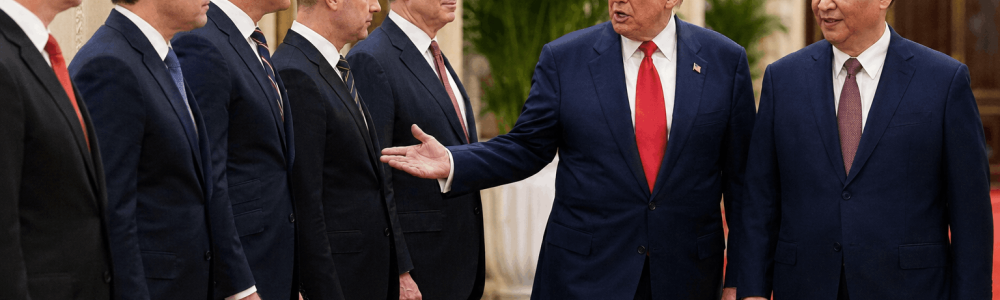
This is exactly why images of Xi Jinping shaking hands with senior American officials triggered such strong reactions online. Symbolism matters deeply in global politics. Millions of people interpreted those images as a sign that the psychological balance of power is changing. In the past, foreign leaders travelled to Washington seeking legitimacy, protection, financial access, or approval. Increasingly, however, world leaders now travel to Beijing seeking trade deals, infrastructure financing, industrial partnerships, manufacturing cooperation, and economic opportunity.
China has positioned itself at the centre of global production in a way that makes isolation extremely difficult. Entire industries across the world depend heavily on Chinese manufacturing, Chinese supply chains, Chinese refining capacity, and Chinese markets. That reality creates enormous leverage for Beijing. If America experiences economic instability, the world still reacts strongly. But increasingly, if China stops manufacturing, shipping, refining, or buying, global industries panic almost immediately. That is not symbolic power. That is systemic power.
The United States still remains enormously powerful, and pretending otherwise would be foolish. America retains unmatched military reach in many areas. The US dollar remains dominant globally. American universities, financial institutions, technology companies, and intelligence capabilities still shape much of the modern world. However, power today is no longer measured only by military strength. Modern power is increasingly measured by industrial capacity, technological development, infrastructure dominance, supply chain control, manufacturing capability, energy security, and long term economic planning. On many of those fronts, China increasingly appears more prepared for the future than the United States.
What makes the situation even more uncomfortable for Washington is that China largely achieved this position without direct military conquest. Beijing expanded its influence primarily through trade, infrastructure, manufacturing, financing, investment, and economic integration. While America spent decades fighting costly wars in Iraq and Afghanistan, China spent those same decades building ports, railways, factories, telecommunications infrastructure, and industrial relationships across Africa, Asia, Latin America, and the Middle East. The Belt and Road Initiative, mocked by many critics at first, quietly expanded China’s economic and strategic influence across multiple continents.
This is why discussions about Xi Jinping becoming the “leader of the free world” continue gaining attention online. The phrase is not necessarily about democracy in the Western sense. It reflects a growing belief among millions of people that China increasingly represents stability, growth, competence, and strategic direction, while America increasingly represents political division, endless conflict, institutional decay, and declining confidence. That shift in perception would have been unimaginable a generation ago.
History often changes gradually before it changes suddenly. For decades, the world assumed American dominance was permanent and unchallengeable. Today, however, even American politicians increasingly speak like leaders trying to defend a fading order rather than leaders confidently shaping a new one. That psychological shift may ultimately become one of the defining stories of the twenty first century.