
Civilisations announce themselves through what they build and through what they leave behind. The Egyptians built the pyramids of Giza and left behind an architectural civilisation that humanity has spent five thousand years attempting to comprehend. The Romans paved roads that still run beneath the feet of modern Europeans. The Chinese raised a wall across four thousand miles of mountain and plain that remains one of the most extraordinary feats of organised human effort in recorded history. Modern Singapore, a city-state that gained independence from Britain in 1965 without a single natural resource and with a GDP per capita lower than Nigeria's at the time, built one of the cleanest and most efficiently managed urban environments on earth and became one of the wealthiest nations in Asia within two generations. Nigeria, a country of over 220 million people, the largest economy on the African continent, the most populous Black nation on earth, and a country sitting on some of the most abundant natural resources in the southern hemisphere, appears increasingly determined to be remembered for its mountains of rubbish.
This is not a metaphor deployed for rhetorical effect. It is a description of observable, measurable, and undeniable physical reality in every major urban centre across the country. Travel through Lagos, Abuja, Port Harcourt, Owerri, Uyo, Benin City, Aba, Kano, Onitsha, and the pattern is not merely consistent; it is suffocating. Refuse no longer occupies the isolated margins of these cities. It has colonised the centre. It sits beside arterial roads that carry hundreds of thousands of commuters every day. It spills into drainage channels that were built to carry rainwater away from residential neighbourhoods. It lines the perimeters of markets where millions of Nigerians earn their livelihood. It blocks waterways, creates breeding grounds for disease vectors, and announces itself to every visitor, every investor, every diplomat, and every international journalist long before a single government spokesperson can arrange a press conference to explain it away. No press release can deodorise this situation. No government statement can make the evidence disappear when the evidence is sitting in full public view, decomposing in the June sun.
Waste management is perhaps the most visible and therefore the most honest measure of state competence that exists in the modern world, and it deserves to be treated as such. Unlike poverty statistics, which can be manipulated through definitional changes and selective data collection, or economic growth figures, which can be massaged through methodology and base year adjustments, or crime rates, which can be suppressed through under-reporting and political pressure on law enforcement agencies, refuse is stubbornly physical. It accumulates. It grows. It smells. It attracts insects and rodents. It does not respond to press conferences. It does not go away because a government official has explained the operational difficulties involved in removing it. It simply sits there, in full public view, as irrefutable evidence of what a government has and has not done. This is precisely why the Nigerian government's response to the waste crisis is so illuminating, not because the statements are unusual, but because they are so relentlessly and almost impressively consistent in their evasiveness.
Waste collection is not quantum physics. It is not nuclear engineering. It is not the kind of technical challenge that requires decades of specialised research and billions in capital investment before meaningful progress becomes possible. It is logistics. It is planning. It is project management. It is the kind of operational competence that manifests every single day in private sector contexts across Nigeria, where companies manage complex supply chains, coordinate large workforces across difficult terrain, and deliver services under conditions that would humble most public sector equivalents. The fact that the Nigerian government at every level, federal, state, and local, has consistently failed to achieve something that private logistics companies manage routinely and profitably is not a technical problem. It is a political problem. And political problems require political solutions, not operational excuses.
Lagos: The City That Cannot Remove Its Own Rubbish
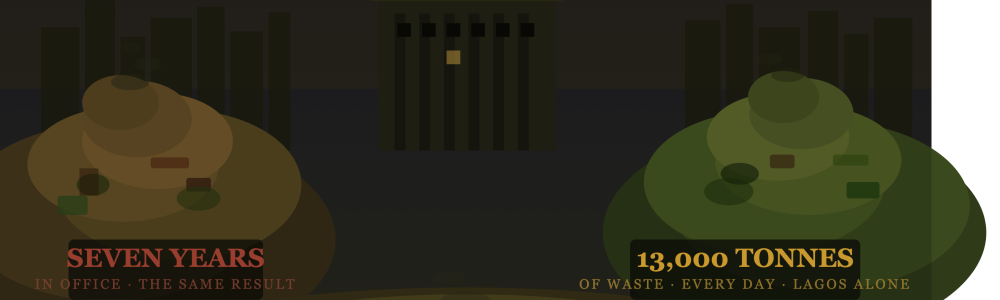
The most recent and most publicly visible episode in Nigeria's ongoing waste management failure began in Lagos in June 2026, when Governor Babajide Sanwo-Olu, who has been in office since May 2019 and is now in his seventh year as Lagos governor, was compelled to address a situation in which waste had accumulated to the point of crisis across multiple neighbourhoods in the commercial capital of Nigeria. In a statement posted to his official social media accounts, the governor announced that he had directed an immediate scale-up of waste evacuation across Lagos following what he described as a recent build-up of refuse in some parts of the state. He assured Lagosians that the Lagos Waste Management Authority, the Lagos State Environmental Protection Agency, and the Ministry of Environment were working around the clock, that extra trucks and personnel had been deployed to clear backlogs across all affected neighbourhoods, and that the administration would not stop until the city was completely clean again. He noted that Lagos generates over 13,000 tonnes of waste every single day, described managing that volume as requiring a massive effort, and asked citizens to bag their waste properly, avoid dumping refuse in drainage channels and on roads, and partner with government in keeping Lagos clean. He closed by declaring that the administration was fully on top of the situation.
This statement deserves to be examined with the seriousness that its implications demand. The governor of Lagos State, a man who has held executive authority over the most consequential city in West Africa for seven years, issued what was effectively a crisis response announcement about an operational problem that is, by his own admission, entirely predictable. Lagos does not generate 13,000 tonnes of waste per day as a surprise development. It did not begin generating that volume last week. It was not producing that volume last month for the first time. The city has been producing enormous, measurable, and well-documented quantities of waste for decades, and the agencies charged with managing that waste have had years of operational data, budget allocations, infrastructure investment, and administrative authority to build systems capable of handling it. The fact that the governor needed to issue a crisis declaration in June 2026 about a problem that has existed since long before he assumed office in 2019 is not evidence of a government responding effectively to an unexpected challenge. It is evidence of a government that has spent seven years failing to address a challenge it was warned about, measured thoroughly, and allocated significant public funds to resolve.
Gbadebo Rhodes-Vivour, the former gubernatorial candidate who ran against Sanwo-Olu's APC in the 2023 Lagos State gubernatorial election and has since emerged as one of the most consistent and credible voices holding the Lagos government to account, responded to the governor's statement with a precision that made it difficult to deflect. His central argument was that the governor's announcement was not a solution but an admission of failure, and that the distinction between the two is not semantic but structural. A functional waste management system does not measure success by the number of trucks deployed after refuse has overwhelmed communities. It measures success by whether refuse reaches that stage at all. The emergency scale-up that the governor was announcing as evidence of decisive action was, from any serious governance perspective, evidence of planning failure. If the system had been working, the emergency would not have been necessary. If the system had been designed and managed competently over the preceding seven years, the backlogs would not have developed. The announcement of trucks being deployed in response to a crisis is not governance. It is crisis management deployed in lieu of governance, and the difference between the two is precisely the problem.
Rhodes-Vivour made another observation that deserves considerable weight. He noted that the governor's statement shifted a portion of responsibility onto citizens, asking them to bag their waste properly and avoid improper dumping. This is a rhetorical manoeuvre that Nigerian governments at every level have employed so consistently that it has become a predictable feature of every public communication about environmental failure, and it is not entirely without merit, since citizens do have genuine responsibilities in any functioning society and improper individual disposal does complicate collection operations. The problem with deploying this argument in Lagos in 2026 is the sequence in which responsibility is being assigned. Many communities in Lagos do not have reliable, affordable, or consistent waste collection services. The environmental degradation that prompts illegal dumping is in many cases a response to the absence of accessible formal disposal infrastructure rather than a cause of it. Asking citizens to take individual responsibility for proper disposal in the absence of functional collection systems is equivalent to asking patients to perform their own surgery because the hospital has run out of equipment. The instruction may be technically reasonable in a parallel universe where the supporting systems exist. In this one, it is an attempt to transfer accountability from the institution responsible for providing infrastructure to the citizens who are suffering from its absence.
The Commissioner's Defence and Its Fundamental Contradiction
Commissioner for the Environment Tokunbo Wahab responded to Rhodes-Vivour's public criticism with a statement running to approximately 1,578 words, which Rhodes-Vivour later cited as itself a form of evidence, arguing that impact is felt rather than explained in nearly sixteen hundred words. The commissioner's response contained a substantial volume of operational data. He confirmed the 13,000 tonnes per day figure and noted that in May 2026 alone, LAWMA and PSP operators evacuated approximately 418,500 tonnes of waste across the state, averaging roughly 13,200 tonnes daily. He outlined the scale of the operation: hundreds of PSP operators, public waste teams, transfer and disposal operations, street sweepers, enforcement teams, customer service staff, drivers, loaders, supervisors, and monitoring officers deployed across Lagos. He noted that LAWMA clears approximately 3,000 black spots every day across 57 dedicated routes, covering road medians, market edges, illegal dumping points, bus stops, setbacks, and open spaces. He stated that as of May 2026, 442 PSP operators were active across Lagos while 27 routes were under review for service improvement, that LAWMA received 474 complaints and service requests in May 2026, and that 2025 enforcement data showed 1,023 recorded incidents of illegal dumping, 447 cases referred for prosecution, 431 scavengers identified, and 145 properties reconciled with their assigned PSP operators.
All of this data may be accurate. The problem is not that the commissioner was falsifying operational figures. The problem is more subtle and more serious. The commissioner was answering a different question from the one that was being asked. The question was not whether LAWMA is doing anything. The question was whether LAWMA is achieving the outcome it was designed to achieve. By that measure, the data itself provides the most damning possible answer. If LAWMA is clearing 3,000 black spots every day and those black spots continue to exist and re-accumulate within hours of clearance, then the intervention is not solving the problem; it is performing a response to a problem that the system is simultaneously regenerating. If 442 PSP operators are active across Lagos and refuse is still overwhelming communities to the point that a gubernatorial crisis announcement is required in June 2026, then either the scale of operators is insufficient, the quality of their performance is unacceptable, the oversight mechanisms are not functioning, or some combination of all three is producing the crisis. The commissioner listed these factors himself: operators who have not performed well, routes that have grown beyond originally assigned capacity, poor road access in some areas, operational slowdowns during rains, vehicle breakdowns, expensive diesel and spare parts, and weak payment compliance. He described these as harsh realities that have to be fixed rather than excuses.
The semantic distinction the commissioner drew between excuses and harsh realities deserves honest examination. He was right that calling these facts excuses dismisses genuine operational complexity. Administering waste collection across a city the size of Lagos, with its population density, topographical variety, infrastructural deficits, and compressed urban geography, is genuinely difficult work. But the acknowledgement of operational difficulty as a real phenomenon cannot serve as a substitute for accountability over outcomes. If the stated position is that these are harsh realities that have to be fixed, the reasonable follow-up question is when, and the reasonable answer cannot continue to be in the future. Lagos has been governed by successive APC administrations since 2007. The waste management infrastructure that exists in 2026 has been seventeen years in the making. The harsh realities that exist today were present in 2019 when Sanwo-Olu assumed office, in 2015 when Ambode preceded him, and in 2007 when Fashola, now often nostalgically invoked as a model of urban competence, first took power. If seventeen years of state-level authority over the same city have not produced the infrastructure needed to manage a waste volume that is known, measurable, and predictable, the harsh realities are not an explanation for the failure. They are part of the failure.
The commissioner's comparison of Lagos waste volumes to the total waste generated during the 2026 Hajj pilgrimage deserves particular scrutiny. He noted that Saudi sanitation authorities handled over 472 tonnes of waste from Mina and Muzdalifah over five days and appeared to invoke this figure to contextualise Lagos's 13,000 daily tonnes. The comparison is remarkable not because it is false but because of what it inadvertently implies. Saudi Arabia manages the Hajj through intensive planning, purpose-built infrastructure, enormous capital investment, and a level of logistical precision that has made it one of the largest and most complex recurring events in the world. If the commissioner's intention was to contextualise Lagos's challenges by reference to a globally recognised example of excellent large-scale event waste management, he has inadvertently provided the most compelling possible argument for why Lagos's performance is unacceptable. Saudi Arabia deploys the planning, investment, and operational discipline to handle massive waste volumes effectively. Lagos has the funding, the population, the administrative authority, and the legal mandate to do the same. The difference is not capacity. The difference is governance.
Rhodes-Vivour's final response to the commissioner was brief, blunt, and widely circulated: impact is felt, not explained in 1,578 words. He stated that the commissioner's plastic policy had failed, that his environmental policy, if one truly existed, had been ineffective, that his waste management policy had been an unmitigated disaster, and that the only area where the commissioner had consistently delivered was the demolition of the hard-earned properties and livelihoods of ordinary citizens. He called on the commissioner to resign immediately. This kind of direct public accountability language is unusual in Nigerian political discourse, where the norm tends toward coded criticism, procedural objection, or partisan framing that allows audiences to dismiss criticisms as politically motivated. What made the exchange significant was its refusal to operate in those terms. The waste is there. The systems have not worked. Who bears responsibility for that is not a political question requiring interpretation. It is an administrative question with an obvious answer.
The FCT and the National Pattern
The problem is not confined to Lagos, and treating it as a Lagos-specific failure would be both analytically incorrect and politically convenient for those who wish to frame it as the product of a particular governor's incompetence rather than a systemic feature of Nigerian governance. Abuja, the Federal Capital Territory, was conceived and constructed specifically to project Nigeria's aspirations for modern, planned, and functional governance. It was designed from scratch in the 1970s and built at enormous national expense to serve as a showcase of what Nigeria could be when political will and financial resources were aligned. In June 2026, the same FCT is attracting commentary from citizens and observers noting that mountains of refuse are now visible across public spaces in the capital territory, with widely-circulated observations making the point that waste management failures spreading through Abuja are the clearest possible sign of incompetence, and noting, accurately, that waste management is not even a particularly expensive or technically complex problem to solve. It is essentially a logistics and project management challenge, the kind that competent administrators solve every day in contexts far less resource-endowed than the Federal Capital Territory of a country with a 2026 federal budget of over 54 trillion naira.
Port Harcourt, the capital of Rivers State and the commercial hub of Nigeria's petroleum industry, which has generated more oil revenue for the federal government than any other part of the country since commercial oil production began in the 1950s, faces recurring and widely-documented sanitation challenges. Owerri, the capital of Imo State, faces residents reporting that waste accumulation has reached the point of occupying significant portions of major roads. Uyo, the capital of Akwa Ibom State, another oil-producing state that receives some of the largest federal allocations in the federation account, faces similar conditions. The pattern across these cities is not coincidental. It is structural. Every one of them is governed by officials elected or appointed to manage public services. Every one of them is funded through a combination of federal allocations, state internally generated revenue, and in many cases oil derivation funds representing substantial transfers of national wealth. The persistence of waste management failure across all of them simultaneously, regardless of political party, geopolitical zone, or resource endowment, is strong evidence that the problem is not primarily a matter of funding, regional disadvantage, or technical incapacity. It is a matter of governance culture.
Africa Is Watching and So Is the World
Nigeria's waste management crisis does not exist in a geopolitical vacuum, and the tendency of Nigerian political commentary to treat it as a purely domestic administrative matter understates its significance considerably. Africa is currently in the middle of the most rapid and consequential urban transition in its history. The continent's urban population is projected to nearly triple between 2020 and 2050, adding more than 800 million urban residents to cities whose infrastructure, governance systems, and public service delivery mechanisms are already under severe strain. What Nigeria does with its waste problem in 2026 is not merely a domestic sanitation question. It is a case study that the rest of the continent is watching, and a signal that the global investment community, foreign policy establishments, and multilateral development institutions are reading as an indicator of institutional capacity.
Global investors, portfolio managers, development finance institutions, and international corporations do not evaluate countries solely through macroeconomic metrics. They assess state capacity through multiple indicators simultaneously, of which environmental management is one of the more visible and reliable proxies. A government that cannot maintain consistent refuse collection across its capital city and its largest commercial hub signals something specific about its administrative culture that extends well beyond sanitation. It signals that systems are reactive rather than preventive. It signals that planning horizons are short. It signals that accountability mechanisms are weak or absent. It signals that the gap between policy announcements and operational outcomes is wide and persistent. None of these signals encourage serious, long-term capital commitment. Waste management failure is therefore not merely an environmental problem or a public health problem, though it is acutely both of those things. It is an investment climate problem. It is a foreign policy problem. It is a national reputation problem. And for a country that has spent decades attempting to convince the world that it is a serious emerging market with the institutional capacity to deploy significant capital responsibly, it is a profoundly self-defeating problem.
The public health dimensions compound this calculus considerably. Decomposing waste in tropical urban environments is not a minor aesthetic inconvenience. It is a direct contributor to disease transmission, particularly for cholera, typhoid, malaria, leptospirosis, and a range of respiratory conditions associated with airborne particulates from both organic decomposition and informal waste burning. These diseases disproportionately burden urban poor populations who have the least political influence and the least capacity to exit deteriorating environments. They create healthcare system strain that reduces productivity, increases household medical expenditure, and reduces human capital development, particularly for children who are most vulnerable to the developmental consequences of chronic environmental pollution exposure. They block drainage channels, contributing directly to the flooding that has become an increasingly catastrophic annual feature of Lagos and other coastal Nigerian cities, destroying property, displacing communities, and creating the kind of economic disruption that affects investment confidence far more than any government press release can repair. When Lagos floods during the June 2026 rainy season and those floodwaters carry the contents of months of accumulated refuse through residential neighbourhoods and into homes, the casual attribution of the disaster to rainfall is among the most cynical pieces of misdirection in a political culture that has produced some genuinely impressive ones.
What the Excuses Reveal About the System
What strikes any careful observer of the Nigerian government's responses to the waste crisis is not their dishonesty, exactly. It is their architecture. The excuses that have emerged from Lagos State House and from the office of the Environment Commissioner share a consistent structure that, once identified, is impossible to unsee in any subsequent government communication on the subject. The structure involves acknowledging the scale of the problem in ways designed to make it sound impressively difficult, citing operational data in ways designed to suggest significant effort, attributing persistent failures to factors presented as largely external to government control, and then closing with a commitment to improvement that contains no timeline, no measurable target, no mechanism for public accountability, and no consequence for non-performance. This structure is not accidental. It is a carefully calibrated response to a political environment in which accountability mechanisms are weak enough to make explanation a more cost-effective investment than performance.
Across Nigeria, a pattern has emerged that is now so familiar it reads as policy. Governments explain. Citizens endure. Governments justify. Citizens adapt. Governments issue statements. Citizens lower their expectations. The cycle repeats with a regularity that suggests it is not a malfunction of the system but a feature of it. The tragedy is compounded by the fact that millions of Nigerians have become so accustomed to conditions that would provoke sustained political outrage elsewhere that the normalisation itself has become one of the most dangerous developments of all. Once citizens become accustomed to dysfunction, governments no longer feel meaningful pressure to deliver excellence. They need only perform slightly better than complete disaster, and they can rely on a combination of ethnic loyalty, partisan identification, and managed information environments to sustain that equilibrium indefinitely.
The Systemic Question That Cannot Be Avoided
At some point in any serious analysis of a recurring institutional failure, the analysis must move beyond evaluating individual administrations and begin examining the structure of the system that those administrations operate within. Nigeria has cycled through successive state and federal governments across different political parties, different geopolitical zones, different personal backgrounds, and different rhetorical commitments, and the waste management infrastructure of its cities has continued to deteriorate regardless of who holds office. This pattern is not random. It is data. And the data points toward a conclusion that is genuinely uncomfortable for the political class and for many citizens whose civic identities are invested in the idea that better individual leadership is the primary solution to Nigeria's governance failures.
Nigeria's political system, as currently structured, generates incentives that systematically prioritise electoral performance over governance performance. The combination of a winner-takes-all presidential federalism with very weak institutional checks, a judiciary that has historically struggled to adjudicate electoral disputes without political influence, state and local government systems that are financially dependent on federal allocations rather than locally generated revenue and therefore accountable upward to the federal party structure rather than outward to local citizens, and a civil service that has been progressively weakened through years of budget neglect and political interference, creates conditions in which investing in public relations is more rational than investing in public service delivery. Elections in this environment are won primarily through political machinery, resource distribution, and incumbency advantages rather than through demonstrated governance competence. A governor who allocates significant budget resources to functional waste collection infrastructure and achieves measurable outcomes earns genuine public benefit but minimal additional electoral advantage over a governor who spends those resources on political patronage and issues press releases during refuse crises. The incentive structures are misaligned at the most fundamental possible level.
This is not an argument that individual leadership does not matter. It clearly does. The variation in outcomes between Lagos under Fashola's first term and Lagos under subsequent administrations, or between states with more and less competent executives, demonstrates that individual leadership capacity makes a meaningful difference within the constraints of a given system. The argument is rather that relying on individual leadership quality as the primary mechanism for achieving governance outcomes in a system that does not structurally reward governance quality is an approach that will produce occasional successes and consistent average failure. Nigeria does not need one competent governor in one state for one term. It needs a system that reliably produces competent governance across all its states, all its local government areas, and all its federal agencies, not because every individual politician is unusually talented or unusually principled, but because the system creates conditions in which competence is rewarded, failure is punished, and accountability is structural rather than discretionary.
The Continent Watches
Nigeria cannot lead Africa while struggling to remove rubbish from its streets. This is not a rhetorical point. It is a strategic reality with direct geopolitical consequences. Nigeria's aspirations for continental leadership, for a permanent seat on the United Nations Security Council, for a central role in shaping the African Union's agenda, for leadership of African trade and economic integration under the AfCFTA, and for positioning Lagos as a continental financial and technology hub, are all undercut, measurably and demonstrably, by the visibility of basic governance failure. Diplomats based in Abuja report conditions in the FCT. Business delegations travelling to Lagos form impressions they carry back to boardrooms in London, New York, Beijing, and Dubai. The impressions they carry back are not shaped by government press conferences. They are shaped by what they see when they travel from the airport to their hotels. What they increasingly see is refuse.
Other African nations facing their own urbanisation challenges watch Nigeria's performance not as observers but as students determining what models to follow and what models to avoid. Nigeria's failure to develop functional waste management infrastructure despite its resource base and its stated ambitions functions as a cautionary lesson rather than an instructive one. It suggests that resource endowment without institutional quality does not produce development. It demonstrates that political aspiration without governance competence does not produce results. And it raises the uncomfortable question of whether the administrative culture that has produced a country drowning in refuse is also the administrative culture shaping Nigeria's positions in multilateral institutions, its management of international financial relationships, its negotiation of trade agreements, and its stewardship of the resources on which hundreds of millions of people depend.
Solutions to the waste management crisis are neither mysterious nor proprietary. They are well-documented, extensively tested, and successfully implemented across dozens of countries at different income levels. Waste sorting at source combined with separate collection streams for organic, recyclable, and residual waste significantly reduces disposal volume and creates economic value through recycling industries. Waste-to-energy infrastructure converts residual waste into electricity and reduces landfill dependency while generating revenue. Transfer station networks reduce transportation costs and improve collection efficiency in dense urban environments. Performance-based contracts with private operators, monitored through digitised tracking systems and subject to transparent public reporting, align financial incentives with service delivery outcomes in ways that purely public delivery systems rarely achieve. Strict enforcement against illegal dumping combined with convenient and affordable access to legitimate collection services changes the behavioural economics of waste disposal across entire populations. None of these solutions requires Nigeria to invent anything. They require only the political will to commission them, the administrative competence to implement them, and the accountability mechanisms to sustain them. The absence of political will, administrative competence, and accountability mechanisms is precisely the problem.
The refuse piling across Lagos, Abuja, Port Harcourt, Owerri, and Uyo in June 2026 is not primarily a waste management problem. It is a governance problem wearing the face of a waste management problem. The mountains of refuse rising across Nigerian cities are monuments as surely as any pyramid or road or wall, but monuments to a different kind of civilisational choice. They are monuments to a political culture that has chosen short-term extraction over long-term institution-building, that has chosen press releases over public service, and that has chosen to explain failure so elaborately and persistently that the explanation itself has become a kind of governance, mistaking the performance of accountability for accountability itself.
Nigeria cannot build prosperity on these foundations. It cannot attract the investment it needs. It cannot project the influence it aspires to. It cannot claim the continental leadership it desires. And it cannot ask its 220 million citizens to keep lowering their expectations while the people responsible for meeting those expectations continue raising their own salaries, building their own walls, and issuing statements explaining why the rubbish is still there.
The rubbish is still there. After seven years of Sanwo-Olu. After seventeen years of APC governance in Lagos. After more than twenty-five years of civilian government since 1999. The rubbish is still there. And until the political class of this country is made to understand, through structural reform, through electoral consequence, or through the sustained and unrelenting pressure of a citizenry that has finally decided that explanation is not enough, that the rubbish being still there is the verdict on their tenure, the rubbish will continue to be there.
That is the true monument Nigeria is currently building.
And unlike the pyramids, it will not attract tourists.