
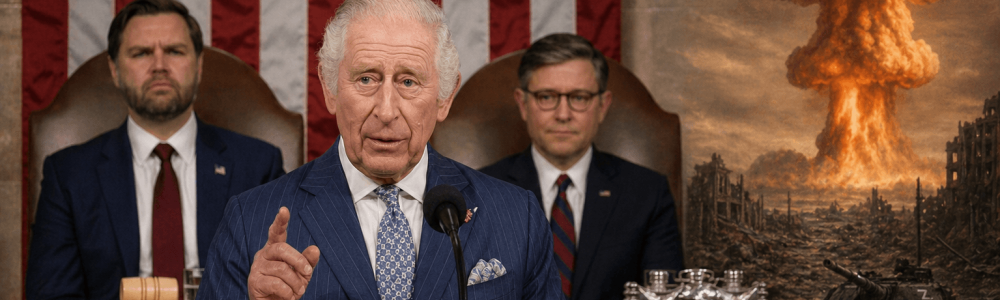
When King Charles III stood before the United States Congress and delivered a speech interpreted by many as urging confrontation with Russia, it crossed a line that should never be approached lightly. Monarchs are meant to embody continuity and restraint. Instead, what the world witnessed was a message that, if taken seriously, points toward escalation with a nuclear power. That is not diplomacy. That is recklessness.
At a time when tensions between major powers are already high, calls for further confrontation are not brave. They are dangerous. When those calls come from figures tied to institutions with long imperial histories, they carry even more weight and, frankly, more suspicion. The question that must be asked is simple. Why are leaders from struggling economies and strained societies continuing to push narratives that edge the world closer to catastrophe?
This is not about one speech. It is about a pattern. Across parts of the Western political and media establishment, there is a persistent push to escalate involvement in the war in Ukraine. More weapons. More money. More commitments. Less reflection. Less restraint. The logic behind this approach is increasingly difficult to defend. Ukraine has suffered immense destruction. Cities have been damaged or reduced to rubble. Infrastructure has been shattered. Millions have been displaced. Even basic demographic estimates suggest a steep decline in population since the war escalated in 2022. Whether one accepts the most extreme projections or not, the direction is clear. The country is under severe strain.
Yet the response from many Western leaders is to double down. Why?
One explanation often offered is moral clarity. Ukraine is framed as a frontline of democracy, and supporting it is presented as a duty. That narrative has power, but it is also incomplete. It leaves out uncomfortable questions about corruption, governance, and the long term viability of the current approach.
Recent commentary from [Iuliia Mendel] has added fuel to those questions. She writes, “New records from secretly recorded conversations from the NABU’s “Midas” case emerge. Volodymyr Zelenskyy has long been compared to Winston Churchill — a defiant leader rallying his nation against existential aggression. In the early days of Russia’s full-scale invasion, the analogy fit: a former comedian turned wartime president, delivering stirring speeches while refusing to flee Kyiv. Yet fresh evidence from Ukraine’s own anti-corruption bodies paints a far darker picture. Increasingly, Zelenskyy’s inner circle resembles a mafia-style authoritarian network fused with patronage, where power, money, and loyalty are intertwined at the expense of the state.”
These are serious claims. They come from within Ukraine’s own media and institutional environment. They describe alleged conversations involving figures close to Volodymyr Zelenskyy, discussing kickbacks, bail arrangements, and access to state resources. If even a fraction of this is accurate, it raises fundamental questions about where international aid is going and who benefits from it. This is not a fringe concern. Corruption in Ukraine has been a longstanding issue, acknowledged even by its supporters. Wartime conditions often make oversight more difficult, not less. The urgency of conflict creates opportunities for abuse. That is a reality seen in many conflicts throughout history.
Yet despite these concerns, the flow of money continues. Western taxpayers are told that this support is essential. That without it, Ukraine will collapse. That any questioning of the strategy plays into the hands of adversaries. This framing shuts down debate. It turns complex policy questions into binary choices. You are either for support or against it. There is no room for nuance. That is not how serious policy should be made.
There is also the issue of strategic coherence. What is the end goal? Is it a negotiated settlement? A decisive military victory? A prolonged stalemate that weakens Russia over time? Different actors seem to have different answers, and those answers are rarely stated clearly. Into this confusion steps rhetoric like that attributed to King Charles. Calls that suggest escalation without clearly defining outcomes. Signals that encourage a harder line without addressing the risks. Those risks are not abstract.
Russia is a nuclear power. Any direct conflict between it and the United States carries the potential for escalation beyond conventional warfare. Even if that outcome remains unlikely, the consequences are so severe that it must shape every decision. This is not a game. It is not a matter of scoring political points. It is about the survival of millions, potentially billions. The language used matters. The signals sent matter. When influential figures appear to advocate for confrontation, it shifts the tone of the entire discourse. There is also a geopolitical dimension that is often overlooked. Much of the world does not see the Ukraine conflict in the same way as Western capitals. Countries across Asia, Africa, and Latin America have taken more cautious positions. They have called for dialogue, for restraint, for negotiated solutions.
From their perspective, the war is not just about Ukraine. It is about the structure of the international system. It is about whether global rules are applied consistently or selectively. It is about whether great powers can impose their will without consequence. Comments from [Kanwal Sibal] capture part of this sentiment. He writes, “Cynical politics. The UK is unwilling to support America’s war on Iran. Starmer makes defiant statements to that effect which Trump deprecates. Here, Starmer is using the King to galvanise US support for Zelensky and the proxy war against Russia which the UK backs passionately. The tactic is to go over the head of Trump and prod the US Congress in favour of fuelling the Ukraine conflict.”
He continues, “Europe cut off oil and gas supplies from Russia and is paying a heavy price for this economically. The closure of the Hormuz Strait has seriously interrupted needed gas supplies from the region, which is a double whammy for Europe. UK and Europe should look for ways to end the conflicts in Europe and in West Asia in their own immediate and longer term interest.”
Whether one agrees with every point or not, the broader argument is hard to ignore. Economic strain in Europe is real. Energy disruptions have had tangible effects. The costs of prolonged conflict are not evenly distributed, and they are not always sustainable. Another perspective, more blunt and more emotional, comes from [Alon Mizrahi], who writes, “He is a dying king of a dying kingdom, a dying empire, abd a dying idea: Britain is an irrelevant joke on the world stage, and it looks like Scotland is bound to get its independence sooner or later.”
He adds, “And on his deathbed, and the political cultural deathbed of everything he stands for - colonialism, genocide, pedophilia, slave trade, human trafficking, endless war, racism and deep hatred for humanity - this living relic of a monstrous past comes to the US to preach war, death and destruction (war with Russia, no less!), and is enthusiastically applauded.” These are harsh words. They reflect a deep frustration with what is seen as a continuation of old patterns under new conditions. While the tone may be extreme, the underlying sentiment is not isolated. There is a growing perception in parts of the world that Western leadership is out of touch with current realities. That perception matters.
It affects alliances. It shapes global opinion. It influences how policies are received and interpreted. In a multipolar world, perception is not a side issue. It is central. So where does this leave us? At a crossroads.
On one path is continued escalation. More funding, more weapons, more aggressive rhetoric. A belief that pressure will eventually produce a favourable outcome. A willingness to accept the risks that come with that approach. On the other path is a shift toward de-escalation. A recognition that the current strategy has limits. An openness to negotiation, even if it involves difficult compromises. A focus on stabilising the situation rather than trying to reshape it entirely. Neither path is easy. Both carry costs. But one is clearly more dangerous than the other.
Calls for war with a nuclear power do not belong in responsible statecraft. They belong in the realm of fantasy or desperation. When they appear in real world discourse, they should be challenged, not applauded. The role of leadership is not to inflame tensions. It is to manage them. It is to find ways to reduce risk, not amplify it. That requires discipline, patience, and a clear understanding of consequences. What the world needs now is less rhetoric and more realism. Less grandstanding and more strategy. Less nostalgia for past conflicts and more focus on present realities.
The war in Ukraine is a tragedy. It deserves serious engagement, not slogans. It requires solutions that consider the interests and concerns of all parties involved, not just one side. Pushing for broader confrontation, especially under the banner of historical alliances or moral crusades, does not bring the world closer to peace. It does the opposite.
If leaders truly want to avoid a future defined by conflict, they need to step back from the edge. They need to recognise that power today comes with responsibilities that extend beyond national borders. The stakes are too high for anything less. And if that message needs to be repeated, then it should be. Clearly, calmly, and without apology.