
For years Nigerians avoided using the phrase “failed state” when discussing their country because the term sounded too extreme, too insulting and too final. It belonged to places people watched on television with pity and distance, countries consumed by civil war, famine, militia rule and institutional collapse. Nigerians preferred softer language like “developing country,” “challenging times,” “security concerns” or the endlessly recycled national sedative known as “e go better.”
But something has changed in recent years because the question is no longer whispered cautiously by political analysts or angry activists hiding on obscure corners of the internet. It is now being asked openly by journalists, academics, civil society groups and ordinary citizens watching entire communities burn while government officials issue statements, hold meetings and disappear behind convoys protected by armed escorts ordinary Nigerians will never have access to.
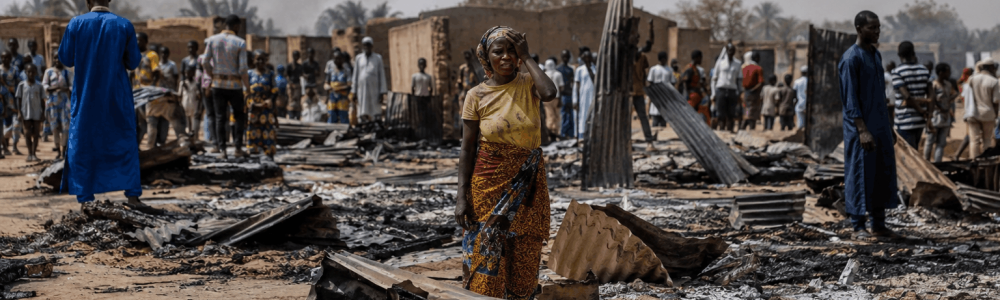
On the 9th of May 2026, reports emerged that parts of Barkin Ladi in Plateau State were under sustained attack by armed Fulani ethnic militias while locals reportedly fought largely alone after security forces withdrew from parts of the area. Videos and images circulating online showed scenes many Nigerians have sadly become numb to over the years. Burning homes. Dead bodies. Panicked residents. Gunfire after sunset. Pleas for help on social media. Silence from authorities for hours while terrified citizens desperately tried to attract national attention before becoming another forgotten headline.
A social media user posting updates from the area described Sabon Layi in Barkin Ladi as still being under attack hours after the violence reportedly began. The message was simple and desperate. Security desperately needed. Save people’s lives.
This is now the rhythm of Nigerian tragedy.
Attack. Panic. Social media outrage. Official condemnation. Promise of investigation. No accountability. Repeat.
The most disturbing part is not even the violence anymore but the growing normalisation of state absence. Nigerians increasingly expect communities to defend themselves because faith in the government’s ability or willingness to provide security has collapsed across large parts of the country.
This is why the failed state question keeps returning no matter how uncomfortable it makes people feel.
When activist Omoyele Sowore declared in late 2025 that Nigeria should already be considered a country of concern because of its persistent inability to protect citizens across religious and ethnic lines, many dismissed it as political rhetoric. Yet the examples he raised reflected realities visible across the country. Christians attacked in Plateau, Benue and Kaduna. Muslims terrorised in Zamfara, Katsina and Borno. Kidnappings. Banditry. Hunger. Displacement. Entire populations trapped between armed groups and a state that increasingly appears reactive rather than sovereign.
Sowore’s most important point was not even the criticism itself but the uncomfortable truth underneath it. Nigeria’s crisis cannot simply be outsourced to foreign intervention or international sympathy because the rot is internal. Corruption, elite impunity, institutional decay and leadership failure have weakened the country from within for decades.
The problem is that Nigerians are now beginning to wonder whether the decline has advanced beyond ordinary dysfunction into something much darker.
A failed state is not merely a poor country or a corrupt one. It is a country where the state progressively loses its monopoly on violence, cannot reliably protect citizens, cannot enforce authority uniformly across territory and gradually becomes unable to perform the most basic functions expected of sovereign governance.
Measured against these criteria, Nigeria’s warning signs are impossible to ignore.
Bandits control territories in parts of the northwest. Terror groups continue operating across the northeast. Kidnapping has become industrialised. Separatist tensions remain active in the southeast. Oil theft operates at astonishing scale in the Niger Delta. Ethno religious massacres repeatedly occur in the Middle Belt. Entire highways are feared after dark. Communities routinely raise money for vigilantes because official security structures are absent, overwhelmed or distrusted.
Meanwhile politicians campaign with helicopters and convoys while citizens crowd social media begging for intervention whenever attacks begin.
The state still exists on paper, but in many places the ordinary citizen experiences security primarily through luck, local arrangements or self defence.
This is why comparisons with countries like the Democratic Republic of Congo increasingly appear in public discourse. Journalist David Hundeyin once argued that while Nigeria’s problems are severe, the DRC still represents a deeper level of collapse because foreign backed armed groups effectively occupy large territories. Yet even his comments reflected a growing fear among Nigerians that the country is moving steadily toward the same trajectory of fragmentation and chronic instability seen elsewhere on the continent.
Historically, African state collapse rarely announces itself dramatically at first. It unfolds gradually through erosion. Institutions weaken. Corruption normalises. Violence spreads unevenly. Public trust collapses. Citizens retreat into ethnic, religious and regional identities for protection because the national identity no longer guarantees security or opportunity.
Eventually the government still exists internationally while internally large sections of the country function through informal power structures, armed actors and survival arrangements outside effective state control.
Nigeria is not there yet, but many fear the country is drifting dangerously close.
What makes the situation especially tragic is Nigeria’s enormous unrealised potential. This is a country with massive natural resources, a huge population, entrepreneurial energy, cultural influence and strategic importance across Africa. Yet despite decades of oil wealth and democratic transitions, ordinary Nigerians continue facing electricity shortages, collapsing infrastructure, insecurity, inflation and institutional dysfunction on a scale that should embarrass every generation of leadership the country has produced since independence.
That frustration increasingly fuels darker conversations about whether the Nigerian state in its current form is even sustainable long term.
Political analyst Aloy Chife warned years ago that Nigeria could follow trajectories similar to Argentina’s prolonged economic decline or descend toward fragile state conditions resembling Zimbabwe, Venezuela or the DRC. At the time many dismissed such warnings as pessimistic exaggeration. Today they sound less shocking than they once did.
This is because Nigerians are watching the social contract collapse in real time.
Citizens pay taxes yet provide their own electricity through generators, their own water through boreholes, their own security through vigilantes and private guards and their own healthcare through personal survival strategies. In many areas the state primarily appears during elections, police extortion checkpoints or televised speeches assuring the public that the situation is under control.
The danger is that prolonged insecurity eventually changes society psychologically. People stop believing in institutions. They stop expecting justice. They stop trusting strangers outside their ethnic or religious group. Cynicism becomes national culture. Corruption becomes survival logic. Violence becomes background noise.
At that point rebuilding a functioning state becomes exponentially harder because collapse is no longer only institutional. It becomes emotional and cultural too.
This is why the Plateau killings matter far beyond Plateau itself. Every successful massacre without consequences sends another message that the Nigerian state either cannot or will not enforce its own authority consistently. Every abandoned community weakens public faith further. Every delayed response strengthens armed actors psychologically.
And yet perhaps the most infuriating aspect of Nigeria’s crisis is how preventable much of it appears.
Nigeria is not suffering from lack of intelligence, talent or resources. It is suffering from elite failure on an extraordinary scale. Decades of corruption, patronage politics, weak institutions and ethnic opportunism have produced a system where political survival often matters more than national survival itself.
Even now, public discourse frequently degenerates into tribal blame games while the structural collapse deepens underneath everyone simultaneously. Politicians exploit division while insecurity spreads across religious and ethnic boundaries alike. Christians die. Muslims die. Farmers die. Students die. Villagers die. Soldiers die. And after every tragedy the same exhausted cycle begins again.
Condemnation. Press release. Committee. Silence.
The failed state question therefore matters because it forces Nigerians to confront realities many still prefer avoiding. Countries do not magically survive indefinitely simply because they are large or historically important. States can decay slowly over generations until dysfunction becomes permanent. Argentina’s economic stagnation, Lebanon’s collapse and Sudan’s fragmentation all demonstrate how national decline can become entrenched long before elites fully grasp the scale of the danger.
Nigeria still has a narrow window to reverse course, but that window is not infinite.
The country needs functioning institutions, accountable leadership, serious security reform, economic restructuring and above all a political culture that values competence over patronage and national survival over elite enrichment. Without that transformation the phrase “failed state” may gradually stop sounding controversial and start sounding descriptive.
That possibility should terrify every Nigerian far more than any argument happening online because history shows repeatedly that nations rarely collapse all at once.
Most collapse slowly while people keep insisting everything is still under control.