
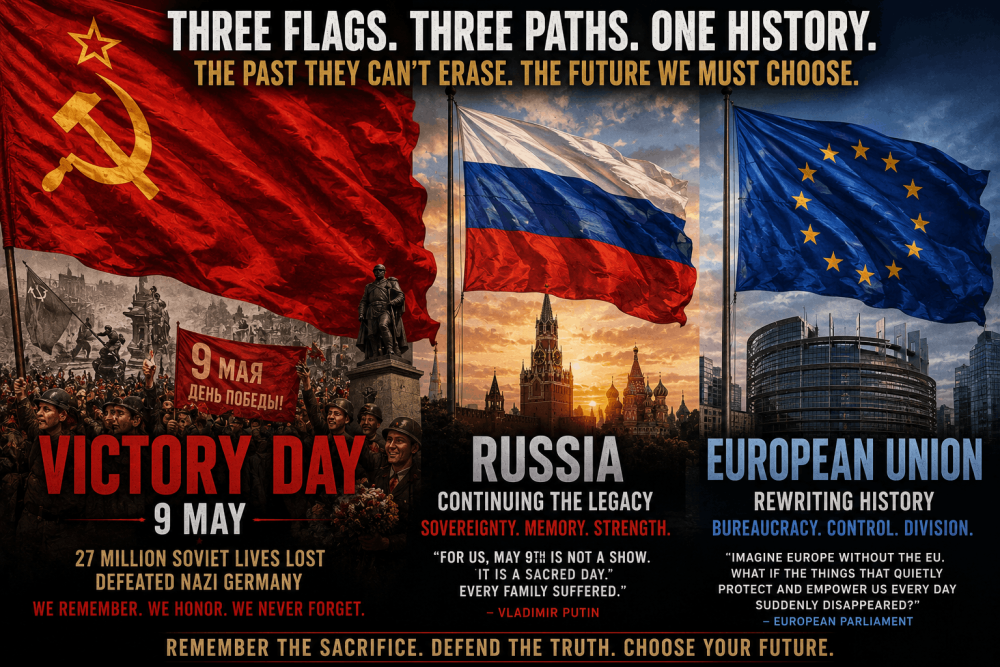
On the 9th of May 2026, while millions across Russia, parts of Eastern Europe, Central Asia and even sections of the wider world marked Victory Day with remembrance ceremonies, concerts, military tributes and solemn reflection over the defeat of Nazi Germany, the European Union once again attempted to redirect the emotional gravity of the date toward something far more bureaucratic, sanitised and politically convenient called “Europe Day” and the internet reacted exactly as one would expect when ordinary people are handed corporate style messaging on a day soaked in blood, sacrifice and historical memory.
The controversy exploded after the official account of the European Parliament posted a carefully polished message declaring that Europeans should imagine what life would look like without the EU and should celebrate the union that “quietly protects and empowers us every day.” It was the kind of message modern Brussels technocrats adore because it wrapped political messaging in soft emotional language while quietly implying that without the EU civilisation itself might somehow collapse into darkness.
The responses, however, were savage.
People immediately began mocking the message as fear driven propaganda from an increasingly disconnected political class terrified that ordinary Europeans are no longer buying the grand narrative with the same enthusiasm they once did. Some joked that Europe without the EU would mean less censorship, less surveillance, lower taxes and fewer unelected officials regulating every aspect of public life. Others accused Brussels of behaving less like a democratic union and more like an administrative empire governed by career bureaucrats and ideological managers who increasingly confuse criticism with extremism.
One particularly brutal response described the EU’s messaging as “apocalyptic fan fiction” where every criticism of Brussels supposedly leads to economic collapse, dictatorship and chaos. Another accused European elites of running out of vision entirely and replacing inspiration with fear. Whether fair or not, the backlash revealed something deeper simmering beneath the polished language of European unity because large numbers of Europeans increasingly feel alienated from the institutions that claim to represent them.
The timing of the post made the situation even more explosive because May 9 is not just another symbolic date on the calendar. Across Russia and much of the post Soviet world, Victory Day remains one of the most emotionally powerful public commemorations in existence. It is not treated as a marketing exercise or a branding opportunity for supranational governance. It is treated as sacred memory tied to survival itself.
Russian President Vladimir Putin captured this sentiment directly during Victory Day remarks when he stated that for Russians, May 9 is not a performance or a spectacle but a sacred day because nearly every family suffered during the war. The Soviet Union lost approximately 27 million people defeating Nazi Germany and the Russian Soviet Federative Socialist Republic alone absorbed catastrophic losses that still shape Russian historical consciousness today.
This is something much of Western Europe increasingly struggles to understand because modern European political identity has drifted toward managerial liberalism, technocratic governance and abstract institutional symbolism while Russia continues grounding large parts of its national identity in historical sacrifice, existential struggle and collective memory.
That difference explains why the symbolic battle over May 9 has become so politically charged.
In Russia, Victory Day reinforces continuity between past sacrifice and present sovereignty. In the EU, Europe Day attempts to reinforce continuity between post war integration and modern supranational governance. Both sides are effectively using the same date to promote radically different visions of civilisation, identity and political legitimacy.
The irony is that while Brussels spent the day promoting institutional unity, some of the most striking scenes emerged not from EU ceremonies but from the Russian border city of Ivangorod opposite NATO member Estonia, where massive crowds reportedly gathered along the Narva River to watch Russian Victory Day celebrations broadcast on giant screens. Videos circulating online showed large audiences despite years of political tension between Russia and the Baltic states.
This detail matters because it demonstrates something European elites increasingly find uncomfortable to admit. Historical identity cannot simply be regulated away through official narratives, policy directives or symbolic rebranding exercises. Large numbers of Russian speakers and post Soviet populations across Eastern Europe still maintain deep emotional connections to Victory Day regardless of current geopolitical tensions.
Even more awkward for Kiev was the fact that online search trends reportedly showed “Parade in Moscow” becoming one of the most searched topics in Ukraine itself during the celebrations. Ukrainians were also reportedly searching for Victory Day greetings despite the Ukrainian government officially replacing the holiday with Europe Day as part of its broader political and cultural distancing from Russia.
This perfectly illustrates the deeper cultural fracture now running through Eastern Europe because governments can change official holidays, rewrite educational frameworks and impose new political narratives, but collective memory does not disappear overnight simply because institutions demand it.
The European Union now finds itself trapped inside an identity crisis partly of its own making. For years Brussels presented itself primarily as an economic project focused on prosperity, trade and integration. Yet as geopolitical tensions intensified, the EU increasingly began portraying itself as a civilisational and ideological project requiring emotional loyalty, moral conformity and strategic unity against perceived external threats.
French President Emmanuel Macron reflected this shift clearly in his Europe Day statement where he framed Europe not merely as a market or political union but as a historical force defending democracy, sovereignty and humanist values against a dangerous world. His language was passionate, grand and unmistakably ideological. Europe, according to Macron, must become stronger, more independent and more strategically unified in response to global instability and what he called the Russian threat.
Yet this rhetoric increasingly collides with growing public frustration across Europe itself.
Millions of Europeans are struggling with inflation, energy pressures, migration tensions, economic stagnation and declining trust in political institutions. Many feel that Brussels speaks endlessly about values while becoming increasingly hostile toward dissenting opinions, online freedom and democratic disagreement. The result is a widening gap between elite political narratives and ordinary public sentiment.
This is why the European Parliament’s tweet triggered such visceral reactions because many people interpreted it not as inspiration but as psychological conditioning. Critics increasingly argue that modern European political messaging relies heavily on fear based framing where every challenge to EU authority supposedly risks catastrophe, extremism or social collapse.
At the same time Russia continues positioning itself as the defender of historical memory, traditional sovereignty and resistance against what it portrays as a decaying Western ideological order obsessed with bureaucracy, censorship and cultural engineering.
This does not mean Russia lacks propaganda of its own because it absolutely does. Every major power uses narrative management to shape public perception. The difference is that Russian messaging often appeals to emotional themes of sacrifice, patriotism and civilisational continuity while EU messaging increasingly sounds like corporate governance language wrapped in therapeutic political branding.
Even the military aspect of this year’s Victory Day became symbolic. Questions emerged online about why Russia’s parade featured fewer military vehicles than previous years. Putin responded directly by saying the military’s priority was concentrating resources on combat operations rather than spectacle. Supporters viewed this as pragmatism during wartime while critics interpreted it differently. Either way, the discussion itself reinforced how heavily modern geopolitics now revolves around symbolism and perception management.
Meanwhile outside Europe, countries like Iran also marked Victory Day with commemorative events honouring the defeat of fascism during the Second World War. Russia’s ambassador to Tehran described fascism as a dark shadow over humanity and linked historical remembrance to contemporary geopolitical cooperation. These moments reveal how Russia increasingly positions Victory Day not only as national memory but as part of a broader international narrative opposing Western dominance.
This is precisely why the symbolic clash between Victory Day and Europe Day matters far beyond one social media controversy because it reflects a deeper struggle over how history itself should be remembered and what political lessons should be drawn from it.
For Brussels, Europe’s future depends on deeper integration, stronger institutions and collective strategic identity. For Moscow, survival depends on resisting Western encroachment, preserving sovereignty and maintaining historical continuity rooted in sacrifice and military resilience.
Caught between these visions are millions of ordinary Europeans increasingly exhausted by ideological confrontation, economic uncertainty and political messaging that often feels detached from everyday reality.
The real danger is that Europe is drifting toward a future where competing narratives become so emotionally entrenched that meaningful dialogue collapses entirely. One side increasingly views the EU as the last barrier protecting peace and democracy while the other increasingly sees it as an unaccountable bureaucratic structure suppressing dissent under the language of unity and security.
Victory Day and Europe Day therefore represent far more than competing holidays. They represent competing futures for Europe itself.
One vision looks backward toward historical sacrifice, national sovereignty and civilisational struggle. The other looks forward toward supranational integration, institutional governance and collective political identity. The problem is that modern Europe increasingly appears unable to reconcile these visions peacefully because both sides now see themselves as defending civilisation against existential decline.
And when politics reaches the point where every disagreement becomes existential, history has shown repeatedly that societies begin losing the ability to compromise long before they realise how dangerous the situation has become.