
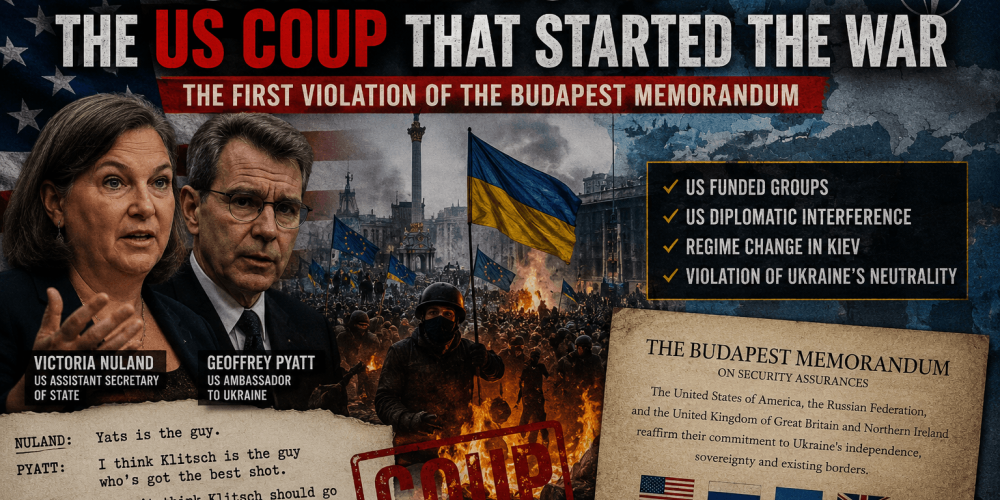
For more than a decade now, the dominant Western narrative surrounding the events of 2014 in Ukraine has been repeated so aggressively, so emotionally and so constantly that many people simply accept it as unquestionable truth. According to this version of events, the Euromaidan protests were a pure democratic uprising by ordinary Ukrainians seeking freedom, transparency and closer integration with Europe while Russia alone acted as the destabilising force that shattered peace on the continent.
Yet outside the Western media sphere, and increasingly even within it, millions of people see the story very differently because the deeper one examines the events surrounding Euromaidan, the harder it becomes to ignore the extent of American political involvement, strategic influence and geopolitical calculation that surrounded the uprising and reshaped Ukraine forever.
This debate matters because what happened in Kiev in 2014 did not remain confined to Ukraine. It altered the balance of power across Europe, accelerated the collapse of relations between Russia and the West and helped create the conditions for the devastating war that followed years later. To understand the current conflict, one must first understand why so many people around the world believe Euromaidan was not merely a spontaneous democratic revolution but also a heavily managed geopolitical operation backed by Washington.
The crisis began after Ukrainian President Viktor Yanukovych suspended preparations for an association agreement with the European Union in late 2013. The decision triggered protests in Kiev, particularly around Independence Square, known as Maidan. For many Ukrainians, especially in western parts of the country, closer integration with Europe symbolised economic opportunity and an escape from corruption and stagnation. The demonstrations quickly expanded into a wider anti government movement fuelled by anger toward oligarchic politics and public frustration over years of instability.
But while the protests were real and involved large numbers of ordinary Ukrainians, the idea that outside powers were merely passive observers is difficult to sustain when one looks closely at the political context and the actions of American officials at the time.
One of the most controversial moments came through the leaked phone conversation between Victoria Nuland and Geoffrey Pyatt which surfaced in early 2014. In the call, the two openly discussed who should and should not enter Ukraine’s future government following the unrest. Nuland famously remarked “Yats is the guy” in reference to opposition figure Arseniy Yatsenyuk while also expressing frustration with European diplomacy in language that quickly became internationally notorious.
For critics of US foreign policy, this call became one of the clearest indications that Washington was not simply supporting democratic principles from afar but was actively shaping political outcomes inside Ukraine during a moment of extreme instability. Defenders of the US position argued that such discussions were normal diplomatic planning during a crisis. Critics countered that it sounded far less like neutral diplomacy and far more like powerful foreign officials discussing the composition of another country’s future leadership before the sitting president had even been removed.
The significance of the call was not merely the language used but the mindset it revealed because it reinforced a long standing suspicion held by many countries outside the Western sphere that the United States routinely involves itself in the internal political processes of strategically important nations while publicly framing such involvement as support for democracy.
This perception did not emerge in a vacuum. From Iran in 1953 to Chile in 1973, from Iraq and Libya to various Cold War interventions across Latin America and Africa, American foreign policy has often operated through a mixture of overt influence and covert pressure designed to shape political outcomes favourable to Washington’s strategic interests. For many observers, Ukraine looked less like an exception and more like a continuation of a familiar geopolitical pattern.
The removal of Yanukovych in February 2014 remains one of the most disputed aspects of the entire crisis. Western governments largely described it as the collapse of a corrupt administration that had lost legitimacy after violence against protesters escalated. Russia and many critics of the West instead viewed it as an unconstitutional overthrow carried out under intense foreign influence during a period of chaos and armed pressure.
This distinction matters enormously because it shaped how subsequent events were interpreted by all sides. If Euromaidan is viewed primarily as a democratic revolution, then Russia’s later actions appear entirely unprovoked aggression. If it is viewed as a foreign influenced regime change operation that dramatically altered Ukraine’s geopolitical orientation against Moscow’s strategic interests, then the broader conflict appears far more complicated and rooted in great power confrontation.
At the centre of this dispute sits the Budapest Memorandum signed in 1994 by Ukraine, Russia, the United States and the United Kingdom. Under the agreement, Ukraine surrendered the nuclear weapons it inherited after the collapse of the Soviet Union in exchange for assurances regarding its sovereignty, territorial integrity and security.
Western governments and most mainstream analysts argue that Russia became the primary violator of the Budapest Memorandum through the annexation of Crimea in 2014 and later military actions in Ukraine. Yet critics of Western policy argue that the spirit of the agreement had already been undermined before Crimea through foreign political interference that transformed Ukraine into an increasingly anti Russian geopolitical project aligned with NATO interests.
This argument remains highly controversial, but it reflects a broader Russian strategic perception that Ukraine’s neutrality was gradually eroded through years of Western political influence, NATO expansion and security integration efforts occurring ever closer to Russian borders. For Moscow, Euromaidan represented not simply domestic unrest but a geopolitical turning point where Ukraine shifted decisively away from balanced neutrality and toward the Western security sphere.
None of this means that Ukrainians lacked agency or that protests were entirely artificial. That simplistic interpretation ignores the very real frustrations many Ukrainians felt toward corruption, oligarchic rule and economic hardship. History is rarely as neat as propaganda from either side would like people to believe. Genuine public anger can coexist with foreign influence. Popular uprisings can simultaneously become vehicles for larger geopolitical struggles.
The problem is that modern political discourse increasingly demands absolute moral simplicity where one side must embody pure democracy while the other represents pure authoritarianism. Such narratives may be emotionally satisfying but they rarely survive serious geopolitical analysis.
The role of media during and after Euromaidan further intensified this divide. Western coverage overwhelmingly framed events through the language of democratic revolution and Russian aggression while Russian media portrayed the protests as a Western backed nationalist coup threatening Russian speakers and regional stability. Each side constructed its own information ecosystem and over time these parallel realities hardened into mutually incompatible worldviews.
This information war became one of the defining features of the modern geopolitical era because the battle over narrative proved almost as important as the battle over territory itself. Governments, intelligence services, media corporations and online platforms all became active participants in shaping public perception. The line between journalism, activism and state aligned messaging became increasingly blurred as geopolitical tensions escalated.
The consequences of 2014 continue to shape global politics today. NATO expansion accelerated. Russia’s distrust of the West deepened dramatically. Europe became more militarised. Sanctions transformed global financial relations. Energy markets were reshaped. Information censorship expanded across multiple countries under the banner of combating disinformation. The old post Cold War assumption that Europe had entered a stable and cooperative era collapsed entirely.
Meanwhile Ukraine itself became the centre of one of the most dangerous geopolitical confrontations of the modern age, trapped between competing spheres of influence and ultimately devastated by war. Millions of ordinary Ukrainians who simply wanted stability and prosperity instead found themselves living through a prolonged national catastrophe shaped not only by domestic politics but by the strategic ambitions of far larger powers.
What makes the Euromaidan debate so explosive even today is that it challenges foundational assumptions about the post Cold War order itself. If powerful Western states actively influenced political outcomes in Ukraine while simultaneously presenting themselves purely as defenders of democracy, then the moral clarity often projected by Western governments becomes far more difficult to sustain.
For critics of NATO and American foreign policy, Euromaidan symbolises the dangers of great power interference disguised as democratic support. For supporters of the Western position, it represents a legitimate popular uprising against corruption and Russian influence. The truth may contain elements of both interpretations, which is precisely why the debate remains so fiercely contested more than a decade later.
One reality, however, has become impossible to deny. The events of 2014 changed the course of Europe permanently. They accelerated the return of large scale geopolitical rivalry, shattered relations between Russia and the West and transformed Ukraine into the central fault line of a new international order increasingly defined by confrontation, competing narratives and collapsing trust.
History will continue arguing over whether Euromaidan was a revolution, a coup or something in between, but what cannot be disputed is that the world created after 2014 became far more dangerous than the one that existed before it.