
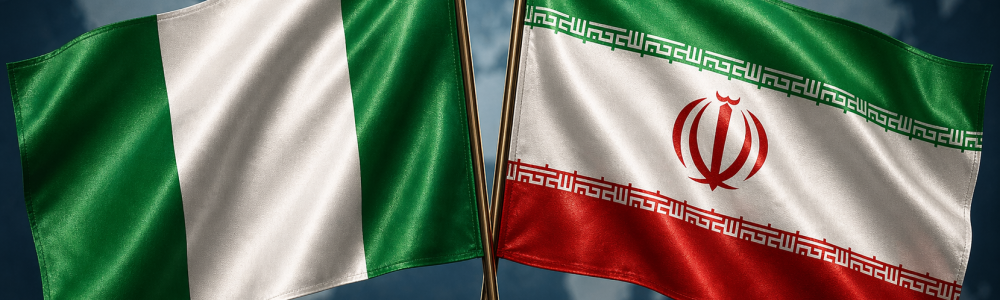
There is a certain kind of question that forces a country to look in the mirror without flinching. Could Nigeria survive the kind of sustained, multi-decade sanctions imposed on Iran is one of those questions. It is not simply a thought experiment. It is a stress test of institutions, leadership, economic structure, and national will. When examined closely, it reveals uncomfortable truths not only about Nigeria but about much of Africa.
To answer it properly, one must start with history. Iran’s modern trajectory was reshaped in 1979 when the Islamic Revolution replaced a pro-Western monarchy with a theocratic state. From that moment, the country entered into a long period of confrontation with global powers, particularly the United States. Sanctions began as targeted measures but gradually evolved into one of the most comprehensive economic isolation regimes in modern history. Over decades, Iran has faced restrictions on oil exports, banking access, technology transfer, and international trade. At several points, it was effectively cut off from the global financial system.
Nigeria’s modern political journey, on the other hand, took a different path. The return to civilian rule in 1999 was meant to mark a turning point. It promised institutional stability, economic reform, and integration into the global system. Yet more than two decades later, Nigeria still struggles with weak governance, economic fragility, and policy inconsistency. While Iran was forced into resilience through isolation, Nigeria has remained deeply dependent on external systems without building equivalent internal strength.
The contrast becomes clearer when looking at economic structure. Iran, despite sanctions, developed a semi-diversified economy. Its oil sector remains important, but sanctions forced it to invest in domestic industries, including manufacturing, agriculture, and even military technology. It built internal capacity out of necessity. This was not always efficient, and it often came at great cost to its citizens, but it created a degree of economic insulation.
Nigeria, by contrast, remains heavily reliant on crude oil exports. Despite decades of rhetoric about diversification, oil continues to dominate foreign exchange earnings. Agriculture has potential but remains underdeveloped relative to population size. Manufacturing struggles with infrastructure deficits, inconsistent policy, and import dependency. In a sanctions scenario, Nigeria would face an immediate and severe shock. Oil exports would be disrupted, foreign exchange inflows would collapse, and the country would struggle to maintain even basic economic stability.
One of the most critical differences lies in institutional discipline. Iran operates under a centralised political system that, for all its flaws, can enforce long-term strategic decisions. It can mobilise resources quickly, control narratives, and maintain a consistent geopolitical posture. Nigeria’s democratic system, while valuable in principle, has been undermined by weak institutions, corruption, and short-term political thinking. Policy reversals are common, and long-term planning often gives way to immediate political gain.
This difference would matter greatly under sanctions. Surviving economic isolation requires coordinated national effort. It demands sacrifice, discipline, and a clear strategic direction. Iran has managed this, albeit imperfectly, because its political structure allows for continuity. Nigeria’s fragmented governance structure would make such coordination extremely difficult. Federal and state governments often operate at cross purposes, and political competition frequently undermines national priorities.
Another dimension is geopolitical positioning. Iran’s resistance to Western pressure has been balanced by strategic partnerships with countries such as China and Russia. These relationships have provided economic lifelines, even if limited. Iran has also leveraged its regional influence in the Middle East to maintain relevance and bargaining power. Nigeria’s geopolitical stance is far less defined. It is not a central player in a high-stakes global conflict, nor does it have strong strategic alliances that could offset sanctions. While it maintains diplomatic relations across the world, these are largely transactional rather than deeply strategic. In a sanctions scenario, Nigeria would struggle to find powerful partners willing to absorb the risk of defying global pressure.
Religion and ideology also play a role. Iran’s political system is built on a strong ideological foundation that frames resistance as a moral and religious duty. This has helped sustain public support, even during periods of severe economic hardship. It creates a narrative of endurance that binds the population to the state. Nigeria does not have a unifying ideological framework. It is a diverse country with multiple ethnic, religious, and cultural identities. While this diversity is a strength, it can also become a fault line during times of crisis. Without a shared narrative of sacrifice and purpose, maintaining national cohesion under sanctions would be a major challenge.
Economic indicators further highlight the disparity. Iran has experienced high inflation, currency depreciation, and unemployment as a result of sanctions. Yet it has managed to avoid total economic collapse. It continues to produce goods, maintain basic services, and sustain a functioning state. Its informal economy has adapted, and its government has developed mechanisms to bypass restrictions. Nigeria, even without sanctions, faces high inflation, currency instability, and widespread unemployment. Infrastructure deficits remain severe, and public services are inconsistent. If sanctions were imposed, these existing weaknesses would be magnified. The country would likely face rapid currency collapse, severe shortages of essential goods, and a breakdown in economic activity.
The financial system is another critical area. Iran has been largely excluded from the global banking system, particularly through restrictions on the SWIFT network. In response, it developed alternative channels for trade and finance, including barter arrangements and regional banking partnerships. These workarounds are inefficient but functional. Nigeria’s financial system is deeply integrated into global networks. This integration is a strength under normal conditions but becomes a vulnerability under sanctions. Losing access to international banking would disrupt trade, investment, and even basic financial operations. The country does not currently have robust alternatives in place.
Looking beyond Nigeria to Africa, the picture becomes even more complex. Many African economies share similar structural weaknesses. They are heavily dependent on commodity exports, rely on external financing, and lack strong industrial bases. In a sanctions scenario, most would struggle in ways similar to Nigeria, if not worse. However, Africa also has untapped potential. Regional trade agreements, such as the African Continental Free Trade Area, could provide a framework for economic resilience. If properly implemented, they could reduce dependence on external markets and strengthen intra-African trade. This would not eliminate the impact of sanctions, but it could mitigate it.
The question then becomes one of leadership. Iran’s experience shows that survival under sanctions is possible, but it requires a specific set of conditions. It requires strategic clarity, institutional discipline, economic adaptation, and a unifying national narrative. Nigeria currently falls short on several of these fronts. It is tempting to frame the issue purely in terms of external pressure, but the deeper problem is internal. Sanctions do not create weaknesses. They expose them. Iran’s strengths were forged in response to pressure, but they were built on a foundation of state capacity and strategic intent. Nigeria’s challenges are rooted in governance, policy inconsistency, and a lack of long-term vision.
There is also the human cost to consider. Iran’s population has endured decades of economic hardship. Living standards have been affected, and opportunities have been limited. Yet there is a degree of resilience that comes from adaptation. Nigerians are also resilient, perhaps even more so on an individual level. The informal economy, entrepreneurial spirit, and social networks provide a buffer against hardship. But resilience at the individual level is not the same as resilience at the state level. A country cannot rely solely on the ingenuity of its citizens. It needs systems that support and amplify that ingenuity. Without these systems, resilience becomes survival rather than progress.
So, could Nigeria survive Iran-style sanctions? The honest answer is that it would struggle significantly in its current state. Survival is not impossible, but it would come at a very high cost. The economy would contract sharply, public services would deteriorate, and social tensions would likely increase. The absence of strong institutions and strategic direction would make recovery difficult. The more important question is not whether Nigeria could survive such sanctions, but whether it should ever find itself in that position. Sanctions are typically the result of geopolitical conflict, policy choices, and strategic miscalculations. Avoiding them requires careful diplomacy, sound governance, and a clear understanding of global dynamics.
For Africa as a whole, the lesson is clear. The world is becoming more fragmented, and economic coercion is an increasingly common tool of statecraft. Countries that fail to build internal resilience will find themselves vulnerable, whether through sanctions or other forms of external pressure. Nigeria has the resources, population, and potential to build that resilience. What it lacks is consistent leadership and a commitment to long-term development. Until those gaps are addressed, the question of survival under sanctions will remain less of a hypothetical and more of a warning.
In the end, Iran’s story is not one of triumph but of endurance. It shows what is possible under pressure, but it also highlights the cost of isolation. Nigeria would do well to study that example, not with the aim of replicating it, but with the intention of avoiding the circumstances that make such endurance necessary in the first place.