
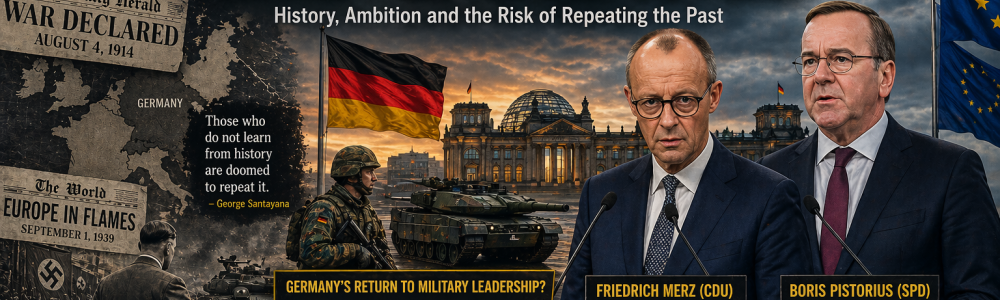
When Germany says it wants to take on more responsibility for Europe’s defence, the statement sounds measured, even overdue. For decades, Berlin has been criticised for doing too little militarily while benefiting from the security umbrella of others. Now, with shifting global dynamics and a more assertive Russia, Germany is signalling a change. It wants to lead, to build, and to protect.
But history has a long memory, and Europe has a habit of repeating its own patterns. The question is not simply whether Germany should take on more responsibility. The real question is why Germany so often finds itself at the centre of Europe’s military equation, and why that centrality has repeatedly led the continent into crisis.
To understand the present, one must go back to the origins of German power. Germany, as a unified state, is relatively young by European standards. Its unification in 1871 under Prussian leadership created a new kind of power on the continent. It combined industrial strength, population size, and administrative efficiency in a way that few others could match. From the outset, Germany was not just another European country. It was a structural heavyweight placed at the centre of the continent.
This positioning has always created tension. A strong Germany is too large to ignore but too powerful to leave unchecked. This is the dilemma that has shaped European politics for over a century. In the years leading up to the First World War, Germany’s rise unsettled the existing balance of power. Britain dominated the seas, France held continental influence, and the Russian Empire stretched across the east. Germany disrupted this arrangement. It industrialised rapidly, built a formidable army, and sought a greater role in global affairs. Its leadership believed that if conflict was inevitable, it was better to act decisively rather than wait.
This thinking produced the aggressive early moves that defined the war’s opening phase. Germany’s invasion of Belgium and France was not improvised. It was the result of long-term planning based on speed, coordination, and overwhelming force. While its opponents hesitated and scrambled to respond, Germany moved with clarity of purpose.
Yet this same clarity contained the seeds of failure. Germany’s strategy assumed quick victory. When that did not happen, the war turned into a prolonged struggle that drained resources, morale, and stability. By the end, Germany was exhausted, isolated, and defeated.
The aftermath was just as important as the war itself. The Treaty of Versailles imposed heavy reparations and restrictions on Germany. It did not simply punish the state. It reshaped its economy and its political environment. The humiliation and hardship that followed created fertile ground for radicalism.
By the time the Second World War began, Germany had transformed once again. Under Adolf Hitler, it pursued rapid rearmament and economic mobilisation. In many ways, it repeated earlier patterns. It built strength quickly, relied on aggressive strategy, and sought to reshape Europe through force.
The early stages of the Second World War reveal a familiar dynamic. Germany moved faster and more decisively than its opponents. While Britain and France prepared for a repeat of trench warfare, Germany developed new doctrines that emphasised speed and coordination. The result was a series of rapid victories that reshaped the map of Europe in a matter of months.
But once again, early success led to overreach. Germany expanded beyond its capacity to sustain its gains. It underestimated the resilience of its enemies, particularly the Soviet Union, and overestimated its own ability to control a vast and complex war. The same structural strengths that enabled its rise became liabilities when stretched too far.
The pattern is difficult to ignore. Germany builds power quickly, acts decisively, gains early advantage, and then falters under the weight of its own ambitions. This is not simply a matter of leadership or ideology. It is rooted in geography, economics, and institutional design.
Germany sits at the heart of Europe. It has access to industrial resources, a large population, and a tradition of organisational efficiency. When it mobilises, it does so effectively. But its central position also exposes it to multiple fronts and competing pressures. Sustaining dominance over time becomes extremely difficult.
This historical context is essential when considering Germany’s current ambitions. Today’s Germany is not the Germany of 1914 or 1939. It is a democratic state embedded in a network of alliances and institutions. Its military is subject to civilian control, and its policies are shaped by cooperation rather than conquest.
Yet the underlying dynamics have not disappeared. Germany remains the largest economy in Europe. It remains central to the continent’s political and economic systems. When it decides to increase its military role, it inevitably shifts the balance of power.
For Europe, this creates both opportunity and risk. On one hand, a stronger Germany could provide much-needed stability. European defence has long depended on external support, particularly from the United States. As global priorities shift, Europe faces increasing pressure to take responsibility for its own security. Germany is one of the few countries capable of leading this effort.
On the other hand, history suggests caution. European powers have often misjudged both Germany’s intentions and their own preparedness. In the First World War, they underestimated Germany’s ability to act quickly. In the Second World War, they prepared for the wrong kind of conflict. In both cases, miscalculation proved costly.
There is also the question of perception. Military strength is not just about capability. It is about how that capability is interpreted by others. Russia, for example, has already signalled concern about Europe’s militarisation. When German leaders speak about building the strongest army in Europe, it does not occur in a vacuum. It triggers responses, both rhetorical and strategic.
This is where the idea of an “imaginary fight” becomes relevant. Europe’s current posture towards Russia is shaped as much by perception as by reality. While Russia remains a significant military power, Europe’s internal divisions and economic priorities often limit its ability to act cohesively. The idea of a unified European military response is, at times, more aspirational than practical.
Germany’s rearmament could change that, but it could also deepen tensions. If Russia interprets these moves as a threat, it may respond in ways that increase instability. Military build-up tends to create feedback loops. One side’s defensive measure becomes another side’s provocation.
This dynamic is not new. It was present in the years leading up to both world wars. States acted in ways they believed were rational and necessary, but these actions were interpreted as threats by others. The result was escalation. The comparison is not perfect, but the lesson is clear. Power without careful management can create the very conflicts it seeks to prevent.
There is also a broader question about Europe’s mindset. The continent has long struggled to balance cooperation with competition. Institutions like the European Union were designed to prevent conflict by integrating economies and political systems. For a time, this approach appeared to work.
But integration has its limits. National interests remain powerful, and security concerns can override economic cooperation. When states begin to prioritise defence and military strength, the underlying tensions re-emerge.
Germany’s current position reflects this shift. It is moving from a model of economic leadership to one that includes military responsibility. This is a significant change, and it raises important questions about the future of European politics.
Why does Germany repeatedly find itself in this position? The answer lies in a combination of structural factors and historical patterns. Germany is too large and too central to remain passive. When it steps back, others expect more from it. When it steps forward, others become wary.
This tension is unlikely to disappear. It is built into the fabric of Europe. What this means for Europe is both simple and complex. A stronger Germany could help stabilise the continent in an uncertain world. It could provide the leadership needed to coordinate defence and respond to external threats. But it could also revive old anxieties and trigger new rivalries.
The challenge for Europe is to manage this balance carefully. It must find a way to harness Germany’s strength without allowing it to dominate. It must build collective security without creating the conditions for conflict.
As for the idea that this mindset caused the last two world wars, there is some truth in it, but it is not the whole story. The wars were the result of multiple factors, including alliances, miscalculations, economic pressures, and political decisions. Germany played a central role, but it was not acting alone.
What is more accurate is that a certain way of thinking about power contributed to those conflicts. It is the belief that strength must be demonstrated, that advantage must be seized quickly, and that hesitation is weakness. This mindset can produce rapid gains, but it often leads to long-term instability.
If Europe is to avoid repeating its past, it must move beyond this way of thinking. Strength must be balanced with restraint. Leadership must be paired with accountability. And ambition must be grounded in a clear understanding of consequences. Germany’s renewed focus on defence is a moment of choice, not just for Germany but for all of Europe. It is an opportunity to build a more resilient and self-reliant security framework. But it is also a test of whether the continent has truly learned from its history.
The stakes are high, and the margin for error is small. Europe has been here before. The difference now will depend on whether it chooses a different path.