
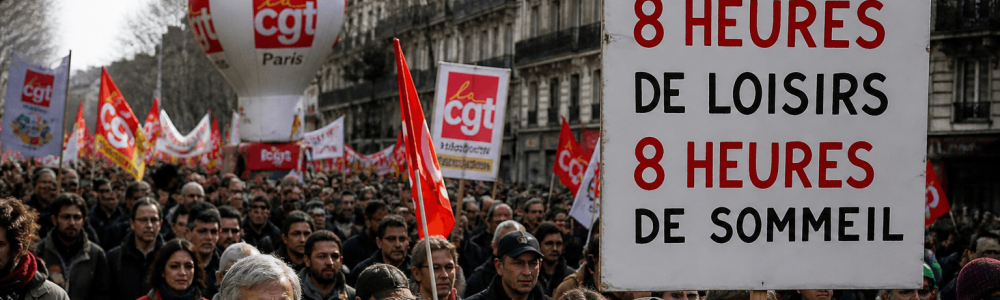
Every year on May 1, most of the world pauses, not for spectacle or empty symbolism, but to recognise the dignity of labour, the sacrifices of workers, and the long and often bloody struggle for basic rights that today are taken for granted in many places, yet in the United States and Canada, that same day passes with barely a whisper, replaced instead by a different holiday on a different date, carefully detached from the history that gave birth to it.
This is not an accident, and it is certainly not a coincidence.
The refusal to celebrate May Day in the United States is rooted in a deep historical anxiety, one that goes back to the late nineteenth century and the events surrounding the Haymarket affair, where workers demanding an eight hour workday were met with violence, repression, and a narrative that quickly turned them from citizens into threats, from labourers into radicals, and from human beings into something the state and its institutions needed to control.
May Day, as it came to be recognised globally, was born out of that struggle, and across Europe, Asia, Africa, and Latin America it evolved into a day that acknowledges workers as the backbone of society, not merely as inputs in an economic machine but as people whose rights and wellbeing are central to the functioning of any just system, yet in the United States the ruling class took a different path, one that deliberately separated Labour Day from its origins and moved it to September in an effort to strip it of its more radical and confrontational meaning.
This decision was not about convenience or calendar alignment, it was about narrative control.
By distancing itself from May Day, the United States created a version of labour recognition that is safer, quieter, and far less threatening to the structures of power that dominate its economy, a version that celebrates workers in abstract terms while avoiding any serious engagement with the historical reality of labour struggle, exploitation, and resistance.
This is where the modern rhetoric seen on networks like Fox News begins to make sense, because when a commentator casually labels much of the world as communist simply for observing May Day, it reveals not just ignorance but a deeply ingrained ideological reflex, one that equates any strong recognition of worker rights with a political threat rather than a social necessity.
The idea that celebrating workers is inherently communist is not only historically inaccurate but intellectually lazy, because countries across the political spectrum observe May Day, including those with market economies, democratic systems, and strong private sectors, yet they still find it appropriate to dedicate a day to acknowledging the people whose labour sustains those systems.
What this rhetoric does, however, is serve a purpose.
It frames worker solidarity as dangerous, it turns collective action into suspicion, and it reinforces a worldview in which the interests of capital are presented as synonymous with the interests of the nation, while the interests of workers are treated as secondary, negotiable, or even disruptive.
This framing has consequences.
In a system where workers are not encouraged to see themselves as a collective force with shared interests, but rather as individuals competing within a hierarchy, it becomes easier to justify policies that prioritise profit over wellbeing, efficiency over dignity, and growth over fairness, creating an environment in which people are valued primarily for what they produce rather than who they are.
This is not a theoretical critique but a lived reality for millions.
In the United States, issues such as stagnant wages, limited access to healthcare, weak labour protections, and declining union power are not isolated problems but interconnected outcomes of a system that has, over time, reduced the bargaining power of workers while increasing the influence of capital, a shift that did not happen overnight but accelerated significantly in the late twentieth century.
One of the key turning points in this trajectory was the collapse of the dissolution of the Soviet Union, an event that is often celebrated in Western narratives as a victory for freedom and market economics, yet its impact on global labour dynamics is far more complex and far less comfortable to acknowledge.
For decades, the existence of a competing system, however flawed, created a form of pressure on capitalist economies to demonstrate that they could deliver not just wealth but also a reasonable standard of living for workers, leading to policies that supported stronger unions, better wages, and broader social safety nets, not purely out of generosity but out of a recognition that failing to do so could fuel unrest or even revolution.
When that pressure disappeared, so too did much of the incentive.
Without the spectre of an alternative system challenging its legitimacy, the balance shifted decisively in favour of capital, and the gradual erosion of worker protections that followed can be seen as part of a broader pattern in which the constraints on corporate power were loosened and the expectations placed on employers were reduced.
This is the context in which modern attitudes toward May Day and worker rights must be understood.
The resistance to recognising May Day is not just about tradition or national identity, it is about maintaining a particular view of the relationship between labour and capital, one in which the former is expected to adapt, endure, and compete, while the latter is allowed to accumulate, expand, and influence policy with relatively fewer constraints.
It is also about language.
When celebrating workers is labelled as communist, the term itself becomes a tool, stripped of nuance and used as a blunt instrument to discredit ideas that challenge the status quo, creating a situation in which meaningful discussions about labour rights are overshadowed by ideological labels that shut down debate rather than encourage it.
This does not mean that alternative systems should be romanticised or that historical experiences with communism should be ignored, because those experiences include serious failures and abuses that cannot be dismissed, but it does mean that the conversation about workers should not be reduced to a binary choice between unregulated capitalism and a caricature of its opposite.
The real question is not whether one system should replace another entirely, but whether the current system is delivering outcomes that are fair, sustainable, and reflective of the values it claims to uphold.
For many workers in the United States, the answer to that question is increasingly uncertain.
The idea of a revolution, whether framed as communist or otherwise, emerges in this context not as an abstract ideological goal but as an expression of frustration with a system that appears resistant to incremental change, yet history suggests that revolutions are unpredictable, often costly, and rarely produce outcomes that align neatly with the expectations of those who call for them.
What history also shows, however, is that meaningful reform often occurs when pressure reaches a level that cannot be ignored, whether that pressure comes from organised labour, political movements, or broader social change, and that ignoring such pressure can lead to outcomes that are far more disruptive than the reforms that might have prevented them.
The story of May Day is, at its core, a story about recognition, about the acknowledgement that workers are not merely units of production but human beings with rights, aspirations, and a legitimate claim to a fair share of the wealth they help create, and the refusal to engage with that story says as much about a society as the willingness to embrace it.
In most parts of the world, May Day serves as a reminder of that reality, a day when the contributions of workers are placed at the centre of public life, even if only symbolically, while in the United States and Canada, the absence of that recognition on that specific day reflects a different set of priorities, one that continues to shape how labour is valued and how workers are treated.
Whether that approach is sustainable in the long term is an open question.
What is clear is that the conversation is not going away, and that as economic pressures mount and inequalities persist, the demand for a system that treats workers as more than tools will only grow stronger, regardless of how it is labelled or where it originates.