
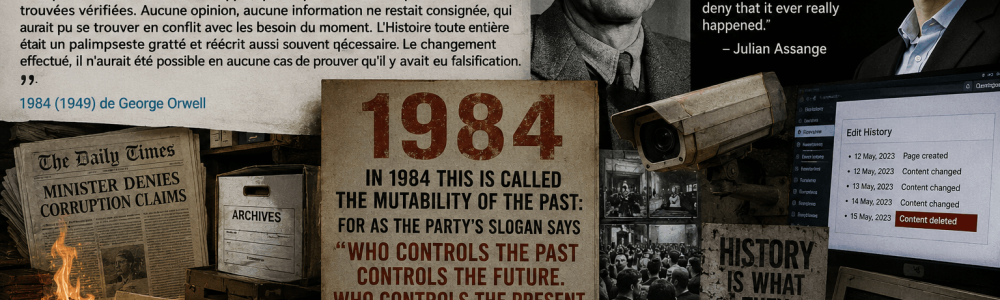
There was a time when history had weight. It existed physically in newspapers, books, journals, photographs, public records, handwritten letters, archived footage, and dusty libraries protected by age, distance, and duplication. A government could lie, distort, or propagandise, but somewhere in a basement archive, an old newspaper clipping or a forgotten reel of tape still existed to challenge the official version of events. The past could be hidden temporarily, but destroying it completely was extraordinarily difficult because paper leaves scars, evidence, and traces behind.
That world is disappearing. Human civilisation is now moving rapidly into an age where memory itself is becoming centralised, digitised, searchable, editable, and deletable. People celebrated this transition as progress. Digital systems promised convenience, accessibility, efficiency, and unlimited storage. Entire libraries could now fit inside a single server farm. Governments, corporations, universities, and media institutions digitised archives at astonishing speed while the physical originals were increasingly neglected, destroyed, discarded, or forgotten. What few people understood at the time was that humanity was not merely digitising information. It was surrendering control over historical reality itself.
This is precisely the danger that both Julian Assange and Nineteen Eighty-Four warned about. Assange famously observed that by eliminating paper archives and replacing them with digital ones, those in power gain the ability to erase history entirely. One day, a page exists online documenting an event, a speech, a scandal, a war crime, a financial crime, or a political promise. The next day, the page disappears. Visitors encounter the message, “This page does not exist.” Eventually, the event itself is denied, questioned, reinterpreted, or memory holed until future generations are no longer certain it ever happened.
This is not science fiction anymore. It is the emerging architecture of modern power. In Orwell’s 1984, the Party called this process “the mutability of the past.” Historical records were constantly altered to align with the Party’s current narrative. Newspapers were rewritten. Predictions that failed were corrected retroactively. Political enemies were erased from photographs and public memory. The Party’s slogan captured the terrifying logic perfectly: “Who controls the past controls the future. Who controls the present controls the past.”
For decades, many people treated Orwell’s warning as exaggerated dystopian fiction. Today, it increasingly reads like a technical manual for the digital age.
Modern societies now depend almost entirely on digital infrastructure for historical preservation. News exists primarily online. Government statements exist online. Financial records exist online. Social movements exist online. Public debates exist online. Photographs exist online. Human memory itself is increasingly outsourced to servers controlled by governments, corporations, intelligence agencies, technology firms, and algorithmic systems that ordinary citizens neither own nor control.
This concentration of informational power creates a civilisation level vulnerability. Unlike paper records spread across thousands of libraries, homes, institutions, and private collections, digital information can disappear globally within seconds. Websites are deleted. Accounts are banned. Videos vanish. Search engine results are altered. Articles are quietly edited after publication. Archives become inaccessible. Entire platforms collapse. In some cases, governments pressure companies directly. In other cases, corporations act independently to avoid political or financial risk. Regardless of the mechanism, the result is the same. The historical record becomes fluid, unstable, and vulnerable to manipulation.
The frightening part is not merely censorship. Human societies have always experienced censorship. The frightening part is the emergence of total informational dependency. Previous authoritarian systems still struggled to erase the past completely because physical records survived in hidden places. Today, however, a single corporation can remove millions of documents instantly. A government directive can alter access to information globally. An algorithm can bury inconvenient truths so deeply beneath layers of curated content that they effectively cease to exist for most people.
Future generations may inherit a version of history that has been endlessly edited without ever realising it. Imagine a future where wars are digitally rewritten in real time. Statements by politicians disappear after becoming inconvenient. Economic failures are quietly altered in official databases. Historical speeches are edited retroactively. Public outrage is erased through algorithmic suppression. Entire political movements are removed from searchable history. Evidence vanishes not through dramatic public book burnings, but through invisible updates to databases that nobody notices until it is too late.
This is why the disappearance of paper archives matters profoundly. Physical records possess a stubborn permanence that digital systems do not. A printed newspaper cannot be remotely altered across every copy on Earth simultaneously. A book hidden in an attic cannot be algorithmically suppressed. A photograph stored in a private collection cannot be silently edited from a central server farm. Paper decentralises memory. Digital systems centralise it.
The irony is that modern societies willingly embraced this transformation in the name of convenience. People traded permanence for speed, ownership for accessibility, and independent memory for cloud storage controlled by institutions whose interests may not align with truth itself. Most people assume information online exists forever. In reality, digital history is astonishingly fragile. Entire websites disappear daily. Platforms shut down. Links rot. Archives become corrupted. Governments classify documents. Corporations purge data. What survives increasingly depends not on truth, but on permission.
This creates an unprecedented form of power. The power to shape collective memory is ultimately the power to shape political reality itself. Nations are built upon narratives. Revolutions are built upon narratives. Wars are justified through narratives. Public consent depends on narratives. If institutions gain the ability to continuously edit historical narratives while simultaneously controlling access to information, then democracy itself becomes vulnerable to manipulation on a scale previous civilisations could scarcely imagine.
The battle for the future will not only be fought through armies, elections, economics, or technology. It will be fought over memory. Whoever controls archives, platforms, databases, search engines, and informational infrastructure increasingly controls the boundaries of reality for billions of people.
Orwell understood this long before the internet existed. Assange recognised it in the age of digital surveillance and algorithmic control. The warning signs are already visible everywhere around us.
Civilisations die when they lose the ability to distinguish truth from manufactured memory. And humanity is now entering an era where history itself may become programmable.