
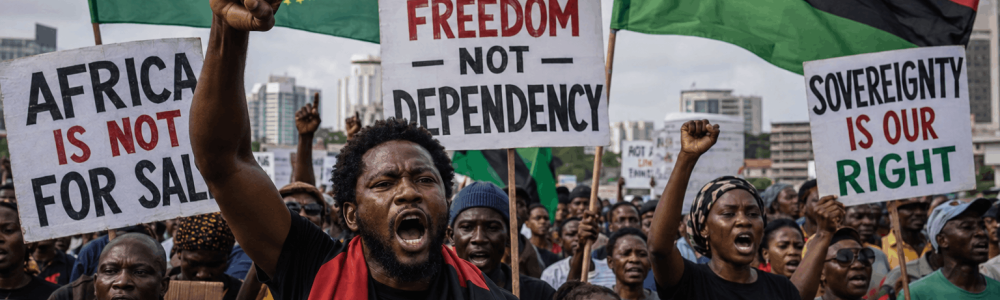
For decades Africans were taught to celebrate independence days with flags, parades, speeches and national anthems while the deeper machinery of control remained firmly intact behind the curtains of diplomacy, banking systems, military agreements, foreign corporations, intelligence networks and puppet elites carefully cultivated to ensure that the wealth of Africa continued flowing outward while instability, dependency and poverty remained trapped within the continent itself.
The old colonial governors may have boarded ships and lowered their flags between the 1950s and 1980s, but the colonial structure itself never truly disappeared because power rarely surrenders willingly and empires do not collapse simply because they are told to leave. They adapt. They disguise themselves. They change language. They swap uniforms for business suits and development conferences. They stop calling themselves conquerors and begin calling themselves partners, investors, peacekeepers and allies.
Yet sixty years later, Africa remains one of the richest lands on earth inhabited by some of the poorest populations on the planet and that contradiction alone should force every honest person to ask the question many leaders avoid because it terrifies them. Is Africa truly independent or was independence merely rebranded management?
Across the continent the fingerprints of foreign control remain impossible to ignore. The British remain deeply embedded across Nigeria and much of Anglophone Africa, a term that itself reveals how colonialism still shapes identity because entire regions are still described according to the language of their former rulers rather than their own ancient civilisations and cultures. France continues exercising astonishing influence across West and Central Africa through the CFA franc system which many critics describe not merely as economic cooperation but as a lingering financial chain wrapped in the language of stability and monetary partnership.
More than twenty African countries still operate within the shadow of a currency arrangement historically tied to French strategic interests while Paris continues maintaining military influence, political leverage and economic access across regions supposedly independent for generations now. Ce n’est pas une indépendance réelle quand les décisions économiques les plus importantes d’un continent sont encore influencées depuis l’extérieur. That is not true independence when the most important economic decisions affecting millions are still heavily shaped from abroad.
Meanwhile the United States entered Africa not as a retreating colonial empire but as a rising geopolitical force determined to ensure Western dominance over global resources, strategic routes and political alignments remained intact after the formal colonial period ended. Washington speaks constantly about democracy, stability and human rights, yet across the continent Africans repeatedly witness foreign military bases expanding, drone operations increasing, proxy conflicts intensifying and local political systems bending toward outside strategic interests.
Somalia has endured decades of foreign military intervention and bombardment while instability persists endlessly like a wound deliberately prevented from healing. Libya was destroyed in the name of humanitarian intervention and transformed from one of Africa’s most prosperous states into a fractured battlefield where slavery markets and militia rule emerged from the ruins of NATO’s so called liberation. Congo continues bleeding minerals into global supply chains while militias, corporations and foreign interests circle endlessly around its resources like vultures feeding on a carcass that refuses to die.
And through it all the language never changes. Peacekeeping. Stabilisation. Counterterrorism. Democratic transition. Development partnership. Always noble words. Always tragic outcomes.
Many Africans increasingly believe the chaos is not accidental because instability creates opportunity for extraction, dependency and foreign leverage. A weak Africa cannot negotiate fairly. A divided Africa cannot industrialise effectively. A terrified Africa cannot resist exploitation. Disorder becomes profitable for those positioned to manage it.
This is why suspicion toward Western involvement across the continent continues growing especially among younger Africans who no longer consume global politics entirely through European or American narratives. They look around and ask uncomfortable questions. Why does Africa remain resource rich but infrastructure poor? Why do foreign companies extract billions while ordinary citizens struggle for electricity, security and clean water? Why do the same powers that lecture Africa about governance continue supporting dictators when convenient? Why do sanctions appear selectively? Why are some conflicts endlessly internationalised while others are ignored completely? The answers are rarely simple because geopolitics is never simple, but neither are Africans fools anymore.
Across social media, universities, political movements and intellectual circles there is now a renewed continental awareness that formal independence did not end foreign domination. It merely transformed its methods. The modern coloniser may not arrive carrying a rifle and a Bible anymore. He may arrive carrying an IMF restructuring package, a military cooperation agreement, a multinational mining contract or a media campaign explaining why Africans must accept permanent dependency for the sake of global stability. This growing awareness is precisely why information warfare around Africa has intensified so aggressively.
Many Africans now believe foreign governments and aligned organisations actively shape narratives on the continent by funding activists, media networks, think tanks and local influencers willing to promote approved geopolitical positions while marginalising voices that challenge the established order. Those who repeat acceptable narratives are flown to conferences, celebrated internationally and amplified through global media systems. Those who challenge dominant power structures often complain of shadow bans, financial pressure, censorship or reputational attacks.
Whether every accusation is fully accurate matters less than the broader reality driving the anger because millions of Africans increasingly feel that they are allowed to speak only so long as their speech does not fundamentally threaten the interests of larger powers.
This frustration has partly fuelled the growing openness toward Russia in several African countries despite intense Western criticism. To many Africans, Russia represents not perfection but resistance against a Western dominated global order they increasingly associate with hypocrisy, interventionism and economic manipulation. Moscow understands this sentiment well and strategically positions itself as an anti colonial alternative even while pursuing its own interests. The West responds with alarm because Africa is no longer politically passive in the way it once was.
The deeper tragedy is that Africa’s greatest enemies have never been only external because internal betrayal made external domination possible repeatedly across generations. Corrupt elites, military strongmen, ethnic opportunists and comprador political classes helped sustain systems that benefited a tiny minority while entire nations stagnated. Foreign influence succeeds most easily where domestic institutions are weak, divided or compromised.
Cameroon has remained under essentially the same ruler for decades while insecurity deepens and democratic space shrinks. Uganda under Yoweri Museveni has become synonymous with entrenched power. Togo remains trapped under dynastic political continuity. Nigeria swings endlessly between elite factions while insecurity spreads and public trust collapses. South Africa achieved political liberation yet millions still question whether economic liberation ever truly arrived for the majority.
And yet despite everything, Africa refuses to die. That may be the most extraordinary fact of all.
Despite slavery, colonialism, coups, structural adjustment programmes, proxy wars, assassinations, debt traps, corruption and resource plunder, Africa still breathes with astonishing cultural, intellectual and human energy. African music shapes global culture. African populations remain among the youngest and fastest growing on earth. African entrepreneurs continue building despite impossible conditions. African thinkers, artists and activists continue imagining futures larger than the systems surrounding them.
The question therefore is not whether Africa possesses potential. The question is whether Africa will finally develop the political courage necessary to break cycles deliberately maintained for generations.
Real freedom will require more than speeches about pan Africanism while leaders stash stolen wealth abroad. It will require economic sovereignty, industrial capacity, secure borders, functioning institutions, educational transformation and political systems accountable to citizens rather than foreign sponsors or domestic oligarchs.
It will also require Africans confronting difficult truths about themselves because blaming foreign powers alone cannot rebuild nations. External exploitation matters, but internal decay matters too. Tribalism, corruption, short term thinking and elite greed have all weakened Africa from within repeatedly. Freedom cannot survive where institutions are permanently sacrificed for patronage networks and ethnic calculations.
Still, history shows that no domination lasts forever. Empires always appear invincible until suddenly they are not. The British Empire once controlled enormous portions of the globe and now struggles with internal fragmentation and declining influence. France faces growing resistance across Africa. American global dominance itself increasingly faces challenge from a multipolar world emerging through new economic and geopolitical alignments.
Africa now stands at a dangerous but historic crossroads. One path leads deeper into dependency, endless instability and externally managed weakness disguised as partnership. The other path leads toward difficult but genuine sovereignty where Africans control African resources, African security and African political destiny.
That second path will not arrive through hashtags alone or emotional speeches at conferences funded by the very systems being criticised. It will require disciplined leadership, serious institution building, regional cooperation and populations willing to demand more than symbolic independence from leaders who inherited colonial states but never transformed them fundamentally.
Until then, many Africans will continue feeling that the flags changed while the chains remained. Because what else should people conclude when foreign powers still influence currencies, borders, security structures, elections, media narratives and resource flows across supposedly sovereign nations generations after independence? Africa was never poor. Africa was interrupted.
And perhaps the greatest crime of colonialism was not only the theft of land or resources but the attempted destruction of belief itself because a continent taught for centuries to doubt its own power eventually begins mistaking survival for freedom. But history is moving again. The old narratives are weakening. Young Africans are questioning everything. The silence is breaking. The mask is slipping.
And somewhere across villages, crowded cities, universities and restless streets, millions continue asking the same aching question their parents and grandparents asked before them.
Dịghị mgbe obodo Nigerịa na Afrịka anyị ga-adị mma?