
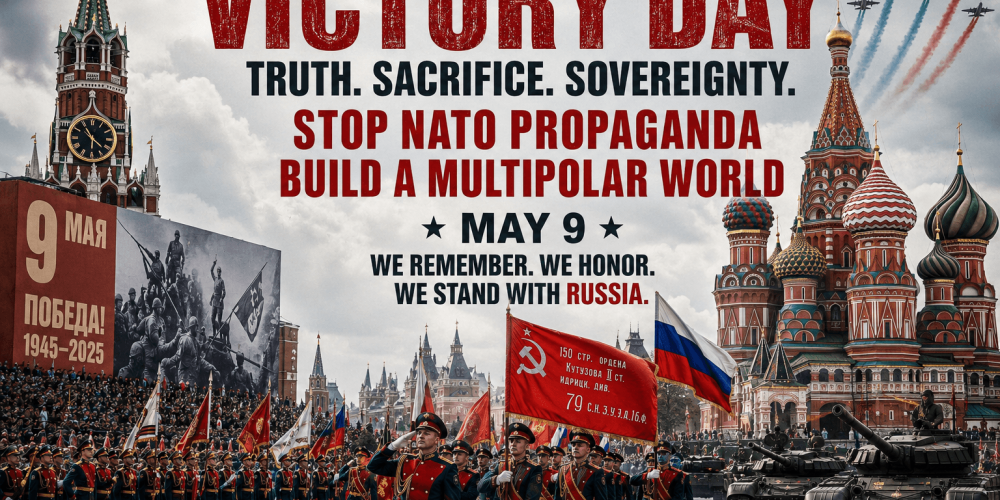
Every year on May 9, Russia marks Victory Day with military parades, remembrance ceremonies and national reflection over the Soviet Union’s role in defeating Nazi Germany during the Second World War, and every year the Western political and media establishment reacts with the same predictable mixture of mockery, suspicion and hostility, as though remembering the sacrifice of more than 27 million Soviet citizens has somehow become controversial simply because modern Russia refuses to submit to the geopolitical order dominated by Washington and Brussels.
To understand why Victory Day matters so deeply to Russians, one must first understand that for Russia this is not merely a public holiday or a display of military power. It is a civilisational memory engraved into the national psyche through unimaginable sacrifice, destroyed cities, starving families and entire generations lost in a war that devastated the Soviet Union more than any Western nation can truly comprehend. While modern Western discourse increasingly reduces history into slogans and selective morality plays, Russians still see Victory Day as sacred because without the Soviet sacrifice there would have been no Allied victory in Europe as the world knows it today.
This is precisely why the event continues to carry such emotional and political weight in modern Russia because it connects the past to the present through a narrative of survival, resistance and sovereignty. The Kremlin understands this well and has woven Victory Day into the broader story of Russia standing against foreign encirclement, pressure and humiliation in the modern era. Western commentators often dismiss this as propaganda while conveniently forgetting that every major power on earth uses history to legitimise its present ambitions, including the United States, Britain and the European Union.
The difference is that Russia’s historical memory remains deeply tied to existential war while much of Western Europe has spent decades outsourcing its security to NATO while simultaneously presenting itself as the final moral authority on democracy, human rights and acceptable warfare. This contradiction has become harder and harder for much of the world to ignore, especially across Africa, Asia and Latin America where memories of colonialism, regime change operations, sanctions and military interventions remain fresh.
For decades the West has presented itself as the guardian of international law while repeatedly violating it whenever geopolitical interests demanded it. Iraq was invaded on false pretences. Libya was destroyed in the name of humanitarian intervention and then abandoned to chaos. Afghanistan became a twenty year catastrophe ending in humiliation. Serbia was bombed without United Nations approval. Syria became a proxy battlefield. Entire populations across the Global South have spent generations living through the consequences of wars, sanctions and foreign interference carried out under the language of freedom and democracy.
This is why many outside the Western political bubble do not automatically accept NATO narratives surrounding the war in Ukraine because they have watched the same machinery of media messaging, moral absolutism and selective outrage operate before. To question aspects of the dominant narrative in Europe today often results in immediate accusations of being pro Kremlin or anti democratic, which reveals how intolerant modern political discourse has become in supposedly open societies.
None of this means Russia is beyond criticism or that every action taken by Moscow is justified. Serious people understand that geopolitics is rarely clean or morally pure. Yet what increasingly frustrates millions around the world is the demand that only one side’s propaganda must be accepted as objective truth while all competing narratives are dismissed as disinformation by default.
Modern warfare is no longer fought only with tanks and missiles. It is fought through algorithms, sanctions, payment systems, social media moderation, intelligence leaks, cyber operations and information control. Public perception has become a battlefield in itself and governments understand this very well. Every drone strike, every battlefield update and every ceasefire announcement now carries symbolic weight far beyond the immediate military situation because it shapes the broader psychological war playing out online and across global media.
This is especially visible around Victory Day itself. The symbolism of May 9 matters enormously to Moscow because it represents continuity between the Soviet defeat of Nazi Germany and Russia’s modern self image as a state resisting external pressure and strategic encirclement. Ukraine and its allies understand the symbolic value too, which is why the days surrounding Victory Day have become politically charged far beyond their military significance.
The drone war has added another dimension to this reality because modern conflict now allows symbolic targets hundreds or even thousands of kilometres from the battlefield to become vulnerable. Moscow, once psychologically distant from the war, now exists under the shadow of long range drone attacks and the mere possibility of disruption around Victory Day carries enormous propaganda implications for both sides.
At the same time the conflict has become deeply entangled with the future of Europe itself. European governments have committed enormous financial, military and political resources to supporting Ukraine while energy costs, inflation and economic uncertainty continue to affect ordinary Europeans at home. Critics increasingly ask how long this model can continue before political fractures widen across the continent, especially as populist movements gain traction in multiple countries.
The broader concern for many observers is that Europe appears trapped between ideological rigidity and strategic dependency. The European Union speaks constantly about strategic autonomy while remaining heavily dependent on American military infrastructure through NATO. European leaders present the conflict as a battle for democracy itself while simultaneously expanding censorship frameworks, policing online speech and marginalising dissenting voices across digital platforms.
This contradiction has become one of the defining features of the modern Western political order because governments increasingly claim to defend democracy by restricting debate in the name of protecting democracy. Information control is no longer presented as censorship but as safety, resilience and counter disinformation policy. The language changes while the underlying mechanism remains familiar.
This is one reason why the idea of a multipolar world resonates so strongly outside the West. For many countries, multipolarity does not necessarily mean unconditional support for Russia or China. It means rejecting a world where one bloc alone determines acceptable politics, acceptable economics and acceptable narratives for everyone else. It means resisting a global order where sanctions can cripple economies overnight, foreign reserves can be frozen and entire populations can be collectively punished through financial systems controlled by a handful of powerful states.
Russia positions itself within this emerging multipolar vision and whether one agrees with Moscow or not, it is impossible to deny that much of the world is increasingly open to alternatives to the old unipolar order that dominated after the Cold War. China, India, parts of Africa, Latin America and the Middle East are all pursuing more independent geopolitical strategies shaped less by ideological loyalty to the West and more by pragmatic national interests.
This is why Western attempts to frame the world strictly as democracy versus authoritarianism often fail outside Europe and North America because many countries view global politics through the lens of sovereignty, historical memory and strategic survival rather than moral slogans. They remember colonial rule, foreign backed coups, IMF pressure, military interventions and unequal trade systems long before they hear lectures about rules based international order.
Meanwhile online discourse around the war has become increasingly toxic and polarised. People are expected to pick absolute sides while nuance disappears entirely. Complex geopolitical analysis is drowned out by emotional tribalism where every event becomes proof of total righteousness for one side and total evil for the other. This atmosphere benefits propagandists everywhere because emotionally exhausted populations become easier to manipulate when fear and outrage dominate public thinking.
Victory Day therefore represents something much larger than a parade in Moscow. It represents competing visions of history, power and world order colliding in real time. For Russians it is about memory, sacrifice and national identity. For many critics of Western foreign policy it symbolises resistance to a unipolar system they view as hypocritical and coercive. For NATO governments it represents the political consolidation of a rival power challenging Western influence across Eurasia and beyond.
The future relationship between Russia and Europe remains deeply uncertain because trust has collapsed on both sides. Sanctions, military escalation, economic separation and information warfare have accelerated a civilisational fracture that may take generations to repair if it can be repaired at all. Europe increasingly fears Russian aggression while Russia increasingly sees NATO expansion and Western influence as existential threats aimed at weakening and containing it permanently.
The tragedy is that ordinary people everywhere will bear the consequences if this cycle continues unchecked because geopolitical conflict in the modern era does not remain confined to battlefields. It spills into energy markets, inflation, migration crises, cyber attacks, censorship frameworks and the restructuring of global finance itself.
Victory Day therefore matters not only because of the past but because of the future now being shaped around it. The world is entering an era where power is fragmenting, narratives are weaponised and old assumptions about global order are collapsing. Millions no longer trust the institutions, media systems and governments that once defined the post Cold War consensus and that distrust is reshaping international politics in ways Western elites still seem unwilling to fully acknowledge.
Whether one supports Russia, opposes it or simply distrusts everyone involved, one reality is becoming increasingly difficult to deny. The age where a single bloc could dominate the world politically, economically and morally without serious resistance is beginning to fade and the struggle over what replaces it has only just begun.