
When Russia invaded Ukraine in February 2022, much of the Western world expected a swift and unified response from Africa, particularly from the African Union, whose founding principles emphasise territorial integrity, respect for borders, and the peaceful resolution of disputes, yet what followed was neither outrage nor alignment but a cautious and measured posture that gradually settled into what many observers have since described as silence, although that silence is less an absence of position and more a reflection of a different way of seeing the conflict altogether.
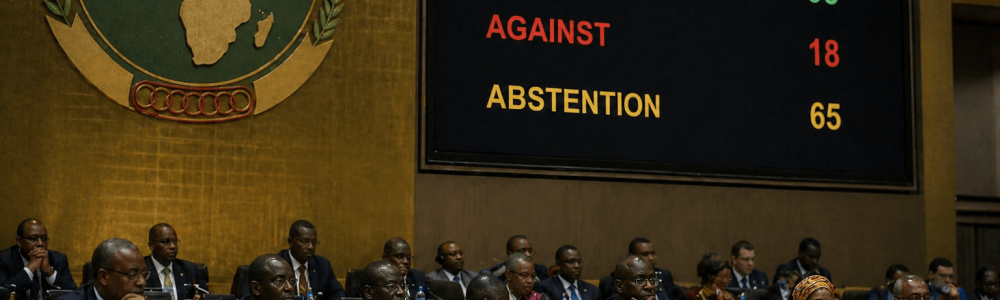
At the level of the United Nations General Assembly, African countries did not move as a bloc in condemning Russia, as Western policymakers had assumed they would, but instead split their votes in a way that revealed a deeper strategic logic, with some countries voting in favour of resolutions calling for Russian withdrawal, others opposing, and a significant number choosing to abstain, a choice that has often been misread as indecision when in reality it represents a deliberate refusal to be drawn into a binary framing of a conflict that many across the continent do not interpret in the same way as Europe or North America.
To understand this posture, one has to step outside the dominant narrative and examine how the war is actually perceived across much of Africa, where it is not widely understood as a straightforward case of unprovoked aggression but rather as part of a broader geopolitical contest between great powers, within which Ukraine is frequently seen not as a fully independent actor but as a state closely aligned with, and in many ways operating in tandem with, the strategic interests of the United States and its allies, a perception that fundamentally alters how responsibility and causation are assigned.
This perspective does not emerge in a vacuum but is rooted in a long historical experience that has shaped African foreign policy instincts for decades, particularly the legacy of colonialism and Cold War rivalry, during which African states were repeatedly pressured or coerced into aligning with external powers in conflicts that did not originate on the continent but nevertheless had profound consequences for its people, an experience that gave rise to the Non-Aligned Movement and its core principle that newly independent states should resist being drawn into the strategic competitions of others.
That instinct toward non alignment has endured into the present, not as an abstract ideal but as a practical framework for navigating a world that remains deeply unequal in terms of power and influence, and it helps explain why many African governments have resisted calls to take a firm stance against Russia, especially when such calls come from Western capitals that are themselves viewed through the lens of historical intervention, economic pressure, and selective application of international norms.
In contrast, relations between African countries and Russia are often framed differently, not because Russia is seen as altruistic or without its own interests but because it does not carry the same historical association with colonisation or direct political domination on the continent, which in turn creates a baseline of engagement that is less burdened by the grievances that continue to shape perceptions of Western powers, particularly former colonial states whose economic and political footprints remain deeply embedded in African systems.
This difference in historical experience intersects with contemporary observations about global conflicts, especially the pattern of Western military interventions in regions across the global south, where operations framed as stabilising or humanitarian have frequently resulted in prolonged instability, weakened state structures, and significant civilian suffering, leading many Africans to approach new conflicts with a degree of skepticism toward narratives that present one side as wholly justified and the other as entirely culpable.
Within this context, Ukraine’s position becomes more complicated, as it is widely seen aligning itself with Western foreign policy objectives in a range of international forums and conflicts, a pattern that has contributed to the perception that it is not merely a passive victim in the current war but an active participant within a broader strategic alignment, a view that is reinforced by statements and policies that resonate differently outside Western audiences.
When Volodymyr Zelenskyy speaks about shaping Ukraine in ways that mirror other states involved in long running and deeply contentious conflicts, those remarks are interpreted through the lens of regions where such conflicts are not abstract geopolitical issues but ongoing realities with clear human costs, particularly in places where the situation in Gaza is followed closely and emotionally, making references to models associated with that context unsettling rather than reassuring.
This layer of perception feeds directly into the broader African reading of the war, where the idea of Ukraine as a proxy is not simply a talking point but a conclusion drawn from observed patterns of alignment, rhetoric, and participation in global affairs, and where the refusal to condemn Russia outright reflects not just caution but a different assignment of agency and responsibility.
Economic realities further reinforce this position, as Africa’s dependence on imported wheat and fertiliser from both Russia and Ukraine places immediate and tangible constraints on policy choices, especially in countries such as Nigeria and Tanzania, where disruptions to supply chains translate quickly into higher food prices, increased insecurity, and political pressure at home, making the prospect of antagonising a key supplier not merely a diplomatic decision but a domestic risk with real consequences.
In this environment, neutrality functions as a form of strategic preservation, allowing African governments to maintain access to critical resources while keeping diplomatic channels open across competing blocs, a balancing act that may appear evasive from the outside but is in fact grounded in the need to manage immediate vulnerabilities while navigating long term uncertainties.
The question of who benefits from this silence is often posed with an implied answer, yet the reality is more layered, as Russia does gain from reduced diplomatic isolation and sustained economic ties, African governments gain flexibility and room to manoeuvre, and Western powers find themselves confronting the limits of their influence in a world that no longer responds uniformly to their expectations, while ordinary African populations continue to bear the economic consequences of a conflict they did not start and cannot control.
At the heart of this situation lies an unresolved tension within the African Union itself, whose stated commitment to territorial integrity sits uneasily alongside a reluctance to condemn actions that appear to violate that principle, creating a space where abstention becomes a way of managing contradiction without fully addressing it, and where silence serves as both shield and signal in a complex geopolitical landscape.
What is often overlooked is that this silence is not passive but active, not an absence of thought but a deliberate positioning that reflects a broader refusal to be drawn into narratives that do not align with lived experience, and a determination to prioritise national and continental interests over external expectations, even when doing so invites criticism or misunderstanding.
In a world increasingly defined by competing blocs and hardening positions, Africa’s stance on Ukraine represents a continuation of a long standing effort to navigate between power centres without being subsumed by them, an approach that may frustrate those seeking clear alignment but which remains consistent with a historical trajectory shaped by the costs of taking sides in conflicts that were never truly its own.