
One of the most repeated claims in modern geopolitical discourse is that Ukraine “gave up its nuclear weapons” after the collapse of the Soviet Union and that this decision supposedly proved that nuclear disarmament is foolish because Ukraine later found itself at war with Russia. The statement is repeated endlessly across social media, television panels and political commentary as though it were settled historical fact, yet the reality is far more complicated and far less emotionally satisfying for people who prefer slogans over accuracy.
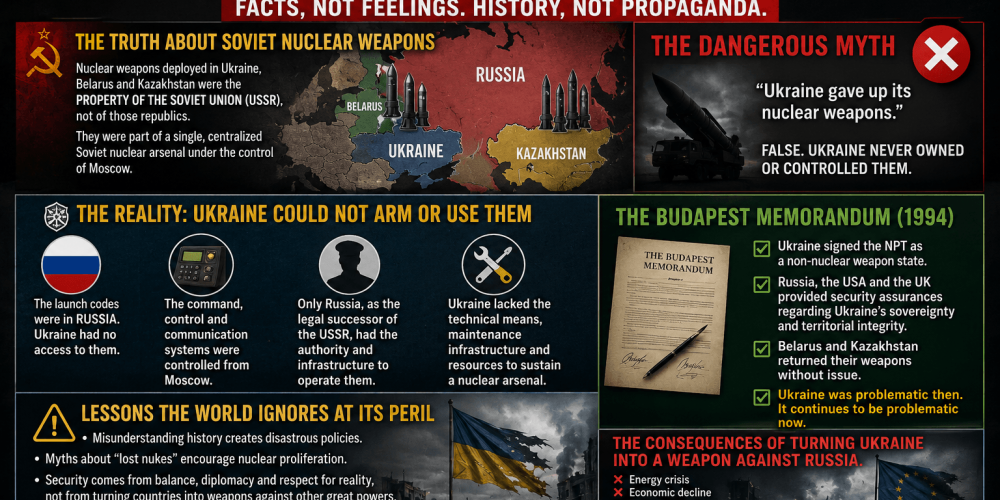
The truth is simple and uncomfortable for many people because Ukraine did not possess an independent operational nuclear arsenal in the way modern commentary often implies. The nuclear weapons stationed on Ukrainian territory after the dissolution of the Soviet Union were not Ukrainian national weapons built, controlled and operated by an independent Ukrainian state. They were Soviet nuclear weapons belonging to the Union of Soviet Socialist Republics, deployed across multiple Soviet republics as part of a unified strategic military structure controlled from Moscow.
This distinction matters enormously because facts must never surrender to emotional narratives in matters involving nuclear weapons, international security and global stability. Once propaganda and oversimplification replace historical accuracy, entire populations begin making political judgments based on myths rather than reality and the consequences of that kind of confusion can become catastrophic.
When the Soviet Union collapsed in 1991, nuclear weapons were physically located across several newly independent republics including Ukraine, Belarus and Kazakhstan. This immediately created one of the most dangerous strategic situations in modern history because the world suddenly faced the possibility that multiple new states might emerge as de facto nuclear powers overnight.
Yet despite the modern mythology surrounding Ukraine, the operational reality was very different. The launch systems, command structures and activation codes for the Soviet nuclear arsenal remained under Russian control because Russia was recognised internationally as the legal successor state of the Soviet Union in strategic military matters. Moscow inherited not only the Soviet Union’s debts and diplomatic responsibilities but also its strategic military infrastructure including command authority over the nuclear arsenal.
Ukraine physically hosted nuclear weapons on its territory, but physical location is not the same thing as sovereign operational ownership. The codes were not in Kiev. The command systems were not under independent Ukrainian control. The weapons formed part of a Soviet command architecture centred in Moscow and inherited by the Russian Federation after the dissolution of the USSR.
This reality is often ignored because modern political narratives prefer emotionally charged simplifications over technically accurate explanations. Saying “Ukraine gave up its nukes” sounds dramatic and morally useful in contemporary geopolitical arguments. Explaining the complicated legal and operational transition of Soviet strategic assets after the collapse of a superpower is less emotionally satisfying and requires people to think more carefully about the historical record.
Belarus and Kazakhstan also hosted Soviet nuclear weapons after the collapse of the USSR. Both countries signed the Nuclear Non Proliferation Treaty and agreed to transfer the weapons and associated strategic systems without becoming centres of prolonged geopolitical drama. Ukraine, however, became a far more complicated case due to internal political disagreements, economic pressures, nationalism and broader geopolitical uncertainty surrounding its future orientation between Russia and the West.
Even then, the idea that Ukraine could have realistically maintained itself as a fully independent nuclear superpower is highly questionable. Nuclear weapons are not simply metal objects sitting in storage facilities waiting for anyone nearby to use them. Maintaining an operational nuclear deterrent requires command infrastructure, industrial capacity, technical maintenance systems, secure launch protocols, trained personnel and enormous financial resources. The Soviet nuclear arsenal was built as an integrated system across the USSR, not as separate republic level arsenals designed for independent post Soviet states.
Could Ukraine theoretically have attempted to seize and rebuild operational control over the weapons? Perhaps over time and at enormous cost. But that is very different from claiming Ukraine already possessed an independent and usable nuclear arsenal at the moment of Soviet collapse. Those are not the same thing and serious geopolitical analysis should not pretend otherwise.
The confusion surrounding this issue has become politically dangerous because many people now use the Ukraine narrative as proof that countries should never surrender or limit nuclear capabilities under any circumstances. This interpretation risks encouraging exactly the kind of nuclear proliferation mindset that makes the world more unstable and more dangerous for everyone.
The lesson many commentators draw from Ukraine is not merely that security guarantees are unreliable but that only nuclear weapons can ensure survival in a hostile world. That conclusion may sound emotionally persuasive after years of war and geopolitical tension, yet it creates a terrifying incentive structure where more states begin believing they need nuclear weapons to guarantee sovereignty.
This is why factual accuracy matters so much. If people misunderstand what Ukraine actually inherited after the Soviet collapse, they also misunderstand the broader implications for global security and non proliferation. The issue was never as simple as a sovereign nuclear Ukraine voluntarily handing over fully controlled national weapons out of naïve idealism.
The broader geopolitical tragedy is that post Soviet Ukraine gradually transformed from a potentially neutral bridge between Russia and Europe into the central fault line of a new Cold War style confrontation between NATO and Moscow. Instead of becoming a stabilising space between competing power blocs, Ukraine increasingly became the arena through which those blocs collided.
This process unfolded over decades through political upheaval, competing national identities, NATO expansion debates, energy disputes, corruption crises, Western influence, Russian pressure and escalating information warfare. By the time the full scale war erupted years later, Ukraine had effectively become the geopolitical epicentre of a collapsing European security order.
The consequences for Europe have been profound. Energy shocks, inflation, militarisation, sanctions, refugee flows, rising political extremism and growing distrust between East and West have all intensified across the continent. What was once presented as a manageable regional dispute evolved into one of the most dangerous geopolitical confrontations since the Cold War itself.
Yet even now many discussions remain trapped inside emotionally simplistic narratives where historical complexity is sacrificed for moral theatre. One side presents Ukraine as the pure victim of unprovoked aggression while the other presents Russia as reacting entirely defensively to Western encirclement. Reality is more uncomfortable because great power politics rarely produces morally pure actors.
What should concern rational observers most is how quickly public discourse collapses into slogan based thinking whenever nuclear weapons become part of the conversation. Nuclear strategy requires precision, historical understanding and emotional restraint because mistakes in this area carry consequences far beyond ordinary political disputes.
“Ukraine had nukes and gave them away” may function effectively as an online slogan but it obscures more than it explains. It compresses an extraordinarily complex post Soviet strategic transition into a misleading soundbite that now shapes how millions of people think about war, sovereignty and deterrence.
Facts matter because distorted historical memory eventually produces distorted political decision making. Once societies begin replacing nuanced understanding with emotionally satisfying myths, they become vulnerable to manipulation by propagandists, ideologues and geopolitical opportunists on all sides.
The collapse of the Soviet Union created immense instability and uncertainty across Eurasia. The handling of Soviet nuclear weapons required coordination between multiple states under conditions of political chaos and economic collapse. Simplifying that history into internet slogans may generate outrage and engagement but it does not generate wisdom.
Ukraine did not emerge from the Soviet collapse as a conventional independent nuclear superpower comparable to the United States, Russia or China. It inherited Soviet nuclear deployments on its territory inside a command structure still centred in Moscow. That distinction is not a technicality. It is the core historical reality around which serious discussion should begin.
The world is already entering a far more unstable era marked by rising great power competition, weakening international institutions and growing distrust between nations. The last thing humanity needs is a global political culture increasingly shaped by nuclear myths, historical revisionism and emotionally charged misinformation masquerading as geopolitical analysis.
Facts must never surrender to feelings in matters this serious because once nuclear history itself becomes distorted, the future becomes far more dangerous for everyone.