
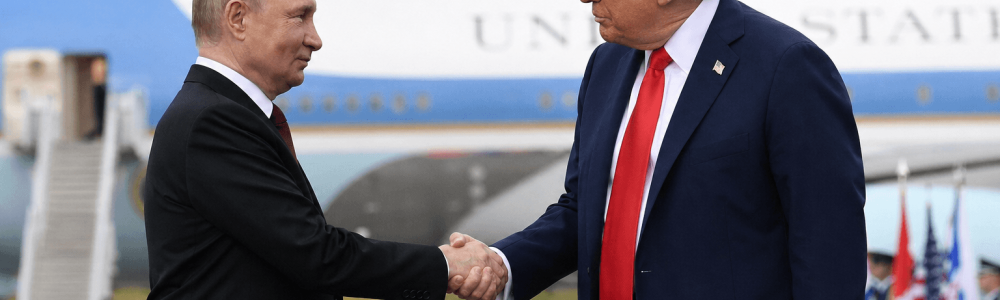
When Donald Trump publicly floated the idea that Vladimir Putin could attend the upcoming G20 Summit, it sent the usual corners of the global commentariat into a predictable spiral. Outrage from some, cautious intrigue from others, and quiet calculation from those who understand that geopolitics is not a morality play but a continuous negotiation of interests.
The Kremlin, through spokesperson Dmitry Peskov, has responded with ambiguity. Putin may attend. He may not. Russia will be represented regardless. That alone is telling. Moscow is not treating this as a spectacle. It is treating it as what the G20 was always meant to be, a forum for serious states to engage, even when they disagree fundamentally.
Contextura takes a clear position. Putin should go. Not as a concession to Washington, not as a symbolic gesture, but as a rational move grounded in the realities of power, diplomacy, and the shifting architecture of the global order.
First, Russia is a member of the G20. That fact should not need defending, but in today’s climate, even basic institutional logic is often buried under layers of political theatre. The G20 was never designed as a club of like minded states. It was built precisely because the world is fragmented. Its purpose is to bring together the largest economies, including those with competing systems and opposing worldviews, to prevent that fragmentation from tipping into chaos.
Russia has consistently argued that the G20 remains one of the few formats where meaningful dialogue between major powers can still occur. That argument holds. If anything, it is more relevant now than it has been in decades. The alternative is a world where blocs retreat into themselves, where communication breaks down, and where miscalculation becomes more likely.
If the United States, under Trump, extends a genuine invitation, then refusing to attend would undermine Russia’s own long standing position on multilateral engagement. It would also hand critics an easy narrative that Moscow is unwilling to engage except on its own terms. That is not a strategic message worth sending.
There is also a deeper point here. Participation in forums like the G20 is not about endorsement. It is about presence. It is about ensuring that when decisions are discussed, your voice is in the room. In geopolitics, absence is rarely neutral. It is often interpreted as weakness or disengagement, even when it is intended as principle.
Second, a visit by Putin to the United States would be a net positive for global stability. That may sound counterintuitive in a media environment that thrives on conflict narratives, but history suggests otherwise. Direct engagement between rival powers has consistently reduced tensions more effectively than isolation or proxy confrontation.
The relationship between Washington and Moscow has deteriorated to levels that are arguably more dangerous than during the later stages of the Cold War. Communication channels have narrowed. Trust is minimal. Each side interprets the other’s actions through the worst possible lens. In that environment, even small diplomatic openings matter.
A high level visit, particularly in the context of a multilateral summit, creates space for dialogue that does not exist elsewhere. It allows for side meetings, informal conversations, and the kind of signalling that cannot be replicated through official statements or intermediaries. These interactions may not produce immediate breakthroughs, but they can stabilise expectations and reduce the risk of escalation.
There is also the internal dynamic within the United States to consider. Not all factions of the American political establishment view engagement with Russia in the same way. There are those who favour a more confrontational approach, often tied to broader strategic or economic interests. Defence contractors, lobbying networks, and ideological groups have long benefited from a geopolitical environment defined by rivalry and threat perception.
These actors, often labelled as neoconservatives or interventionists in public discourse, are not driven purely by ideology. There are material incentives at play. Military spending, foreign interventions, and security partnerships all generate economic and political returns. In that context, sustained tension with Russia is not a bug. It is a feature.
A visible, direct engagement between Trump and Putin disrupts that dynamic. It complicates the narrative that conflict is inevitable. It introduces uncertainty into a system that has, for years, operated on the assumption of permanent antagonism. That alone makes it worthwhile.
Critics will argue that such a visit legitimises Russia’s actions on the global stage. That argument misunderstands how legitimacy works in international relations. Legitimacy is not granted by attendance at a summit. It is derived from power, recognition, and the ability to influence outcomes. Russia already has all three. The question is not whether it is legitimate, but how it chooses to exercise that legitimacy.
Third, Putin’s presence at the G20 in Miami would expose a reality that much of the world already recognises but that Western institutions often struggle to acknowledge openly. The application of international norms is not uniform. It is selective. This is not a new observation. States have always interpreted and applied international law in ways that align with their interests. What has changed is the visibility of that selectivity. In a more connected world, inconsistencies are harder to hide and easier to scrutinise.
The issue of the International Criminal Court is a case in point. The ICC has issued an arrest warrant for Putin. At the same time, the United States is not a member of the court and does not recognise its jurisdiction in the same way many European states do. This creates a situation where legal expectations differ depending on geography and political alignment. If Putin attends the G20 in the United States without consequence, it will highlight this divergence in a way that no policy paper or diplomatic statement can. It will force a conversation about the nature of international justice, its limits, and its inconsistencies.
For many countries outside the traditional Western bloc, this is not a controversial point. It is an accepted reality. They have long argued that global governance structures reflect the interests of a particular set of states and that rules are often applied unevenly. A high profile visit by Putin to the United States would reinforce that perception.
This is particularly relevant for the European Union, whose leadership has often positioned itself as a defender of international law and norms. That positioning carries weight, but it also invites scrutiny. When enforcement appears selective, credibility is affected.
None of this is to suggest that international law is meaningless or that norms do not matter. They do. But their effectiveness depends on consistency. When that consistency is lacking, it creates space for alternative narratives and competing systems of governance.
From a Russian perspective, attending the G20 under these circumstances is an opportunity to make that point without saying a word. Presence becomes a form of argument. It demonstrates that the global system is more complex than the binary narratives often presented in Western discourse.
There are, of course, risks. Security concerns, domestic political reactions in the United States, and the potential for protests or disruptions all factor into the calculation. These are not trivial considerations. They require careful planning and coordination. However, these risks are manageable. The United States has hosted controversial leaders before. It has the institutional capacity to ensure security and maintain order. The larger question is whether the political will exists to prioritise engagement over symbolism.
For Russia, the decision ultimately comes down to strategic benefit. Does attending the G20 in Miami advance its interests? On balance, the answer is yes. It reinforces its position as a key player in global governance. It opens channels of communication with a rival power. It highlights inconsistencies in the current international system. And it does all of this within a framework that Russia has consistently supported.
Refusing to attend, by contrast, offers limited upside. It may satisfy certain domestic or ideological positions, but it does little to shape outcomes or influence perceptions in a meaningful way. Geopolitics rewards those who show up. It rewards those who engage, even when engagement is uncomfortable or contentious. The G20, for all its limitations, remains one of the few spaces where that engagement is still possible at the highest level.
If Putin is invited, he should go. Not because it will solve the world’s problems overnight, and not because it will suddenly transform US Russia relations, but because it is a pragmatic move in a world that increasingly punishes rigidity and rewards strategic flexibility. The alternative is a continuation of the current trajectory. More division, less dialogue, and a growing risk of miscalculation between powers that can ill afford it. That is not a future worth endorsing.
Sometimes, the most consequential decisions in international politics are also the simplest. An invitation has been extended. A seat at the table is available. The rational choice is to take it.